Notes on Novelists, with Some Other Notes — John Shaqi
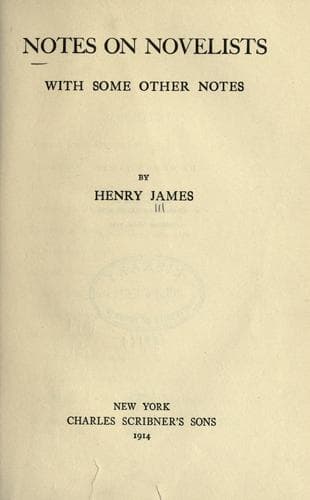
Notes on Novelists, with Some Other NotesJames, Henry
History
Notes on Novelists, with Some Other Notes
James, Henry
Fiction -- History and criticism; Novelists
As for “La Débâcle,” finally, it takes its place with Tolstoi’s very
much more universal but very much less composed and condensed epic as an
incomparably human picture of war. I have been re-reading it, I confess,
with a certain timidity, the dread of perhaps impairing the deep
impression received at the time of its appearance. I recall the effect
it then produced on me as a really luxurious act of submission. It was
early in the summer; I was in an old Italian town; the heat was
oppressive, and one could but recline, in the lightest garments, in a
great dim room and give one’s self up. I like to think of the conditions
and the emotion, which melt for me together into the memory I fear to
imperil. I remember that in the glow of my admiration there was not a
reserve I had ever made that I was not ready to take back. As an
application of the author’s system and his supreme faculty, as a triumph
of what these things could do for him, how could such a performance be
surpassed? The long, complex, horrific, pathetic battle, embraced,
mastered, with every crash of its squadrons, every pulse of its thunder
and blood resolved for us, by reflection, by communication from two of
the humblest and obscurest of the military units, into immediate vision
and contact, into deep human thrills of terror and pity—this bristling
centre of the book was such a piece of “doing” (to come back to our
word) as could only shut our mouths. That doubtless is why a generous
critic, nursing the sensation, may desire to drop for a farewell no term
into the other scale. That our author was clearly great at congruous
subjects—this may well be our conclusion. If the others, subjects of
the private and intimate order, gave him more or less inevitably “away,”
they yet left him the great distinction that the more he could be
promiscuous and collective, the more even he could (to repeat my
imputation) illustrate our large natural allowance of health, heartiness
and grossness, the more he could strike us as penetrating and true. It
was a distinction not easy to win and that his name is not likely soon
to lose.
GUSTAVE FLAUBERT
Public-domain text, read in full here on John Shaqi.
Reviews
Reviews
No reviews yet
Be the first to share your thoughts on this work.
Join the Discussion
Join the discussion
Sign in to leave a comment or review.
Sign InorCreate an account