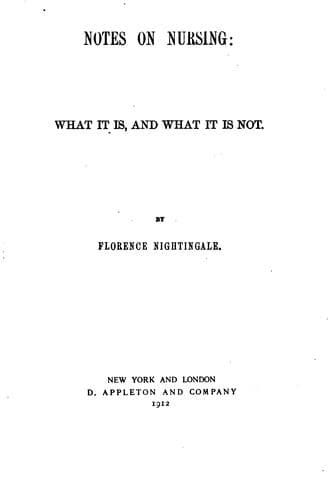
Notes on Nursing: What It Is, and What It Is NotNightingale, Florence
Science
Notes on Nursing: What It Is, and What It Is Not
Nightingale, Florence
Nursing
The sick man to his advisers.
"My advisers! Their name is legion. * * *
Somehow or other, it seems a provision of the universal destinies, that
every man, woman, and child should consider him, her, or itself
privileged especially to advise me. Why? That is precisely what I want
to know." And this is what I have to say to them. I have been advised to
go to every place extant in and out of England--to take every kind of
exercise by every kind of cart, carriage---yes, and even swing (!) and
dumb-bell (!) in existence; to imbibe every different kind of stimulus
that ever has been invented; And this when those _best_ fitted to know,
viz., medical men, after long and close attendance, had declared any
journey out of the question, had prohibited any kind of motion whatever,
had closely laid down the diet and drink. What would my advisers say,
were they the medical attendants, and I the patient left their advice,
and took the casual adviser's? But the singularity in Legion's mind is
this: it never occurs to him that everybody else is doing the same
thing, and that I the patient _must_ perforce say, in sheer
self-defence, like Rosalind, "I could not do with all."
[Sidenote: Chattering hopes the bane of the sick.]
"Chattering Hopes" may seem an odd heading. But I really believe there
is scarcely a greater worry which invalids have to endure than the
incurable hopes of their friends. There is no one practice against which
I can speak more strongly from actual personal experience, wide and
long, of its effects during sickness observed both upon others and upon
myself. I would appeal most seriously to all friends, visitors, and
attendants of the sick to leave off this practice of attempting to
"cheer" the sick by making light of their danger and by exaggerating
their probabilities of recovery.
Far more now than formerly does the medical attendant tell the truth to
the sick who are really desirous to hear it about their own state.
How intense is the folly, then, to say the least of it, of the friend,
be he even a medical man, who thinks that his opinion, given after a
cursory observation, will weigh with the patient, against the opinion of
the medical attendant, given, perhaps, after years of observation, after
using every help to diagnosis afforded by the stethoscope, the
examination of pulse, tongue, &c.; and certainly after much more
observation than the friend can possibly have had.
Supposing the patient to be possessed of common sense,--how can the
"favourable" opinion, if it is to be called an opinion at all, of the
casual visitor "cheer" him,--when different from that of the experienced
attendant? Unquestionably the latter may, and often does, turn out to be
wrong. But which is most likely to be wrong?
[Sidenote: Patient does not want to talk of himself.]
Public-domain text, read in full here on John Shaqi.
Reviews
Reviews
No reviews yet
Be the first to share your thoughts on this work.
Join the Discussion
Join the discussion
Sign in to leave a comment or review.
Sign InorCreate an account