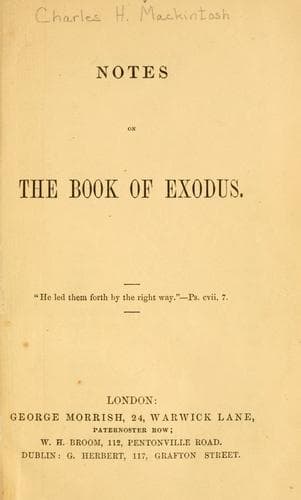
Notes on the book of ExodusMackintosh, Charles Henry
Religion
Notes on the book of Exodus
Mackintosh, Charles Henry
Bible. Exodus -- Commentaries
"And afterward, Moses and Aaron went in, and told Pharaoh,--'Thus
saith the Lord God of Israel, Let My people go, that they may hold a
feast unto Me in the wilderness.'" (Chap. v. 1.) Such was Jehovah's
message to Pharaoh. He claimed full deliverance for the people on the
ground of their being His, and in order that they might hold a feast
unto Him in the wilderness. Nothing can ever satisfy God in reference
to His elect, but their entire emancipation from the yoke of bondage.
"Loose him and let him go" is really the grand motto in God's gracious
dealings with those who, though held in bondage by Satan, are
nevertheless the objects of His eternal love.
When we contemplate Israel amid the brick-kilns of Egypt, we behold a
graphic figure of the condition of every child of Adam by nature.
There they were, crushed beneath the enemy's galling yoke, and having
no power to deliver themselves. The mere mention of the word _liberty_
only caused the oppressor to bind his captives with a stronger fetter,
and to lade them with a still more grievous burden. It was absolutely
necessary that deliverance should come from without. But from whence
was it to come! Where were the resources to pay their ransom? or where
was the power to break their chains? And even were there both the one
and the other, where was the _will_? Who would take the trouble of
delivering them? Alas! there was no hope, either within or around.
They had only to look up. Their refuge was in God. He had both the
power and the will. He could accomplish a redemption both by price and
by power. In Jehovah, and in Him alone, was there salvation for
ruined and oppressed Israel.
Thus it is in every case. "Neither is there salvation in any other;
for there is none other name under heaven, given among men, whereby we
must be saved." (Acts iv. 12.) The sinner is in the hands of one who
rules him with despotic power. He is "sold under sin"--"led captive by
Satan at his will" fast bound in the fetters of lust, passion, and
temper,--"without strength," "without hope," "without God." Such is
the sinner's condition. How, then, can he help himself? What can he
do? He is the slave of another, and everything he does is done in the
capacity of a slave. His thoughts, his words, his acts, are the
thoughts, words, and acts of a slave. Yea, though he should weep and
sigh for emancipation, his very tears and sighs are the melancholy
proofs of his slavery. He may struggle for freedom; but his very
struggle, though it evinces a desire for liberty, is the positive
declaration of his bondage.
Public-domain text, read in full here on John Shaqi.
Reviews
Reviews
No reviews yet
Be the first to share your thoughts on this work.
Join the Discussion
Join the discussion
Sign in to leave a comment or review.
Sign InorCreate an account