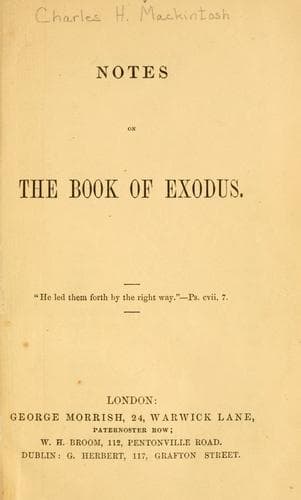
Notes on the book of ExodusMackintosh, Charles Henry
Religion
Notes on the book of Exodus
Mackintosh, Charles Henry
Bible. Exodus -- Commentaries
Nor is it merely a question of the sinner's _condition_; his very
_nature_ is radically corrupt--wholly under the power of Satan. Hence
he not only needs to be introduced into a new condition, but also to
be endowed with a new nature. The nature and the condition go
together. If it were possible for the sinner to better his condition,
what would it avail so long as his nature was irrecoverable bad? A
nobleman might take a beggar off the streets and adopt him; he might
endow him with a noble's wealth, and set him in a noble's position;
but he could not impart to him nobility of nature; and thus the nature
of a beggarman would never be at home in the condition of a nobleman.
There must be a nature to suit the condition; and there must be a
condition to suit the capacity, the desires, the affections, and the
tendencies of the nature.
Now, in the gospel of the grace of God, we are taught that the
believer is introduced into an entirely new condition; that he is no
longer viewed as in his former state of guilt and condemnation, but as
in a state of perfect and everlasting justification; that the
condition in which God now sees him is not only one of full pardon,
but it is such that infinite holiness cannot find so much as a single
stain. He has been taken out of his former condition of guilt, and
placed absolutely and eternally in a new condition of unspotted
righteousness. It is not, by any means, that his old condition is
improved. This is utterly impossible. "That which is crooked cannot be
made straight." "Can the Ethiopian change his skin, or the leopard his
spots?" Nothing can be more opposed to the fundamental truth of the
gospel than the theory of a gradual improvement in the sinner's
condition. He is born in a certain condition, and until he is "born
again" he cannot be in any other. He may try to improve, he may
resolve to be better for the future--to "turn over a new leaf"--to
live a different sort of life; but, all the while, he has not moved a
single hair's breadth out of his real condition as a sinner. He may
become "religious," as it is called,--he may try to pray, he may
diligently attend to ordinances, and exhibit an appearance of moral
reform; but none of these things can, in the smallest degree, affect
his positive condition before God.
Public-domain text, read in full here on John Shaqi.
Reviews
Reviews
No reviews yet
Be the first to share your thoughts on this work.
Join the Discussion
Join the discussion
Sign in to leave a comment or review.
Sign InorCreate an account