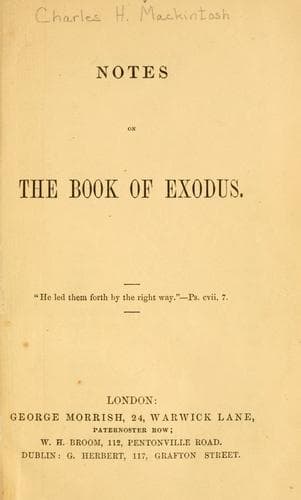
Notes on the book of ExodusMackintosh, Charles Henry
Religion
Notes on the book of Exodus
Mackintosh, Charles Henry
Bible. Exodus -- Commentaries
The case is precisely similar as to the question of _nature_. How can
a man alter his nature? He may make it undergo a process, he may try
to subdue it--to place it under discipline; but it is nature still.
"That which is born of the flesh is flesh." There must be a new nature
as well as a new condition. And how is this to be had? By believing
God's testimony concerning His Son. "As many as received Him, to them
gave He power to become the sons of God, even _to them that believe on
His name_: which were born, not of blood, nor of the will of the
flesh, nor of the will of man, but of God." (John i. 12, 13.) Here we
learn that those who believe on the name of the only begotten Son of
God, have the right or privilege of being sons of God. They are made
partakers of a new nature: they have gotten eternal life.--"He that
believeth on the Son _hath_ everlasting life" (John iii.
36.).--"Verily, verily, I say unto you, He that _heareth_ My word, and
_believeth_ on Him that sent Me, _hath_ everlasting life, and shall
not come into condemnation; but _is_ passed from death unto life"
(John v. 24.).--"And this is life eternal, that they might know Thee,
the only true God, and Jesus Christ, whom Thou hast sent" (John xvii.
3.).--"And this is the record, that God hath given to us eternal life,
and this life is in His Son. He that hath the Son _hath_ life." (1
John v. 11, 12.)
Such is the plain doctrine of the Word in reference to the momentous
questions of condition and nature. But on what is all this founded?
How is the believer introduced into a condition of divine
righteousness and made partaker of the divine nature? It all rests on
the great truth that "JESUS DIED AND ROSE AGAIN." That blessed One
left the bosom of eternal love, the throne of glory, the mansions of
unfading light; came down into this world of guilt and woe; took upon
Him the likeness of sinful flesh; and, having perfectly exhibited and
perfectly glorified God in all the movements of His blessed life here
below, He died upon the cross, under the full weight of His people's
transgressions. By so doing, He divinely met all that was or could be
against us. He magnified the law and made it honorable; and, having
done so, He became a curse by hanging on the tree. Every claim was
met, every enemy silenced, every obstacle removed. "Mercy and truth
are met together; righteousness and peace have kissed each other."
Infinite justice was satisfied, and infinite love can flow, in all its
soothing and refreshing virtues, into the broken heart of the sinner;
while, at the same time, the cleansing and atoning stream that flowed
from the pierced side of a crucified Christ, perfectly meets all the
cravings of a guilty and convicted conscience. The Lord Jesus, on the
cross, stood in our place. He was our representative. He died, "the
just for the unjust." "He was made sin for us." (2 Cor. v. 21; 1
Peter iii. 18.) He died the sinner's death, was buried, and rose
again, having accomplished all.
Public-domain text, read in full here on John Shaqi.
Reviews
Reviews
No reviews yet
Be the first to share your thoughts on this work.
Join the Discussion
Join the discussion
Sign in to leave a comment or review.
Sign InorCreate an account