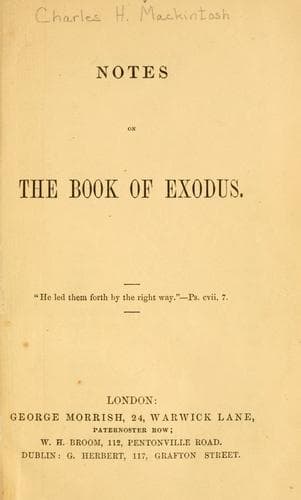
Notes on the book of ExodusMackintosh, Charles Henry
Religion
Notes on the book of Exodus
Mackintosh, Charles Henry
Bible. Exodus -- Commentaries
"Wherefore say unto the children of Israel, 'I am the Lord, and I will
bring you out from under the burdens of the Egyptians, and I will rid
you out of their bondage, and I will redeem you with a stretched-out
arm, and with great judgments; and I will take you to Me for a people,
and I will be to you a God; and ye shall know that I am the Lord your
God, which bringeth you out from under the burdens of the Egyptians.
And I will bring you in unto the land concerning the which I did swear
to give it unto Abraham, to Isaac, and to Jacob; and I will give it to
you for a heritage: I am the Lord.'" (Ver. 6-8.) All this speaks the
purest, freest, richest grace. Jehovah presents Himself to the hearts
of His people as the One who was to act _in_ them, _for_ them, and
_with_ them, for the display of His own glory. Ruined and helpless as
they were, He had come down to show forth His glory, to exhibit His
grace, and to furnish a sample of His power, in their full
deliverance. His glory and their salvation were inseparably connected.
They were afterwards reminded of all this, as we read in the book of
Deuteronomy,--"The Lord did not set His love upon you, nor choose you,
because ye were more in number than any people; for ye were the fewest
of all people: but because the Lord loved you, and because He would
keep the oath which He had sworn onto your fathers, hath the Lord
brought you out with a mighty hand, and redeemed you out of the house
of bondmen, from the hand of Pharaoh, king of Egypt." (Chap. vii. 7,
8.)
Nothing is more calculated to assure and establish the doubting,
trembling heart than the knowledge that God has taken us up _just as
we are_, and in the full intelligence of what we are; and, moreover,
that He can never make any fresh discovery to cause an alteration in
the character and measure of His love. "Having loved His own which
were in the world, He loved them unto the end." (John xiii.) _Whom_ He
loves and _as_ He loves, He loves unto the end. This is an unspeakable
comfort. God knew all about us--He knew the very worst of us, when He
manifested His love to us in the gift of His Son. He knew what was
needed, and He provided it; He knew what was due, and He paid it; He
knew what was to be wrought, and He wrought it; His own requirements
had to be met, and He met them. It is all His own work. Hence, we find
Him saying to Israel, as in the above passage, "I will bring you out,"
"I will bring you in," "I will take you to Me," "I will give you the
land," "I am Jehovah." It was all what _He would do_, as founded upon
what _He was_. Until this great truth is fully laid hold of, until it
enters into the soul, in the power of the Holy Ghost, there cannot be
settled peace. The heart can never be happy, or the conscience at
rest, until one knows and believes that all divine requirements have
been divinely answered.
Public-domain text, read in full here on John Shaqi.
Reviews
Reviews
No reviews yet
Be the first to share your thoughts on this work.
Elsewhere in the archive
Join the Discussion
Join the discussion
Sign in to leave a comment or review.
Sign InorCreate an account