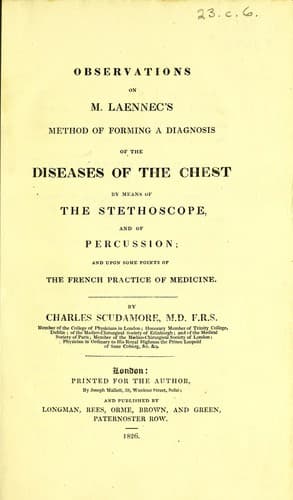
Observations on M. Laennec's method of forming a diagnosis of the diseases of the chest by means of the stethoscope, and of percussion; and upon some points of the French practice of medicine — John Shaqi
Observations on M. Laennec's method of forming a diagnosis of the diseases of the chest by means of the stethoscope, and of percussion; and upon some points of the French practice of medicineScudamore, Charles
Science
Observations on M. Laennec's method of forming a diagnosis of the diseases of the chest by means of the stethoscope, and of percussion; and upon some points of the French practice of medicine
Scudamore, Charles
Chest -- Diseases -- Diagnosis; Laennec, R. T. H. (René Théophile Hyacinthe), 1781-1826
It may be considered therefore that the properties of the seeds
become sufficiently extracted in the stomach and intestinal canal,
to excite the mucous membrane to increased secretion, and also to
influence the action of the nerves. They are found principally useful
to those invalids who suffer from general deficiency of secretion in
the intestinal canal, and from nervous langour. I do not conceive
that they are so proper for persons of the inflammatory diathesis,
and who become easily heated; and I should rather approve of them
as an occasional than a constant remedy, for they are not a certain
aperient, and I do not think it desirable to subject the canal
constantly to this kind of stimulus. If the seeds accumulate very
much, some inconvenience may be occasioned by their augmentation
of bulk, and if they be retained in the intestines, some further
inconvenience may result from the disengagement of sulphuretted
hydrogen.
[6] M. Goupil, who was attached to the Hospital of Val-de-Grâce for
two years, has given a clear view of these doctrines, in a work
entitled Exposition des Principes de la Nouvelle Doctrine Médicale,
&c. Paris, 1824.
[7] With regard to many other medicines, the most useful maximum
of dose is an interesting question. I am certain that the largest
quantity which the stomach will receive, is not the most efficacious.
The action between the medicine and the stomach must be mutual. If we
take, for example, so innocent a medicine as the carbonate of iron,
I expect more effect from the dose of a dram than half an ounce,
which would incommode the powers of the stomach by its mass. The
observation applies to all medicines which are of a very insoluble
nature. I do not mean, in a general sense, that a small dose of a
medicine has equal power with a large one, but that there is a point
of increase, beyond which the efficacy becomes lessened.
[8] Sulphate of quinine may be procured by digesting bruised bark
in repeated portions of diluted sulphuric acid, until the liquor no
longer possess a bitter taste. The different liquors are then to be
mixed together and strained. To the strained liquid, lime is to be
added, until the mixture assume a chocolate brown appearance, and a
precipitate subside to the bottom of the vessel. This precipitate
must be washed with a little cold water, dried, and digested in
alcohol. The alcoholic solution, when submitted to distillation,
leaves, in the retort, a brown viscous liquid, which is to be treated
with a suitable quantity of boiling dilute sulphuric acid and a
portion of charcoal. This solution is lastly to be filtered, and set
aside to cool, when crystals of the sulphate of quinine will form.
Mr. Garden informs me, that the largest portion of the sulphate of
quinine which he has been able to prepare from the best yellow bark,
is as one to fifty.
Public-domain text, read in full here on John Shaqi.
Reviews
Reviews
No reviews yet
Be the first to share your thoughts on this work.
Join the Discussion
Join the discussion
Sign in to leave a comment or review.
Sign InorCreate an account