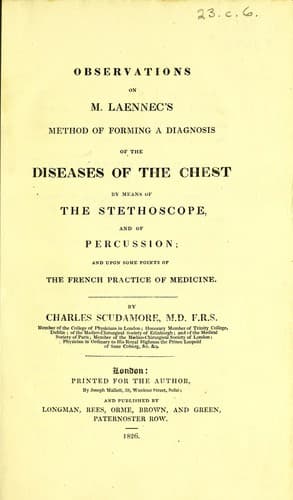
Observations on M. Laennec's method of forming a diagnosis of the diseases of the chest by means of the stethoscope, and of percussion; and upon some points of the French practice of medicine — John Shaqi
Observations on M. Laennec's method of forming a diagnosis of the diseases of the chest by means of the stethoscope, and of percussion; and upon some points of the French practice of medicineScudamore, Charles
Science
Observations on M. Laennec's method of forming a diagnosis of the diseases of the chest by means of the stethoscope, and of percussion; and upon some points of the French practice of medicine
Scudamore, Charles
Chest -- Diseases -- Diagnosis; Laennec, R. T. H. (René Théophile Hyacinthe), 1781-1826
[4] I am happy to state, that an institution similar in principle
to the _Maison Royale de Santé_, is established in London. It is
called the _Asylum for the Recovery of Health_. It is situated in
Lisson Grove. Already it has been highly patronised, and well does it
deserve to grow in the favour of the public. It is supported in part
by voluntary contributions, and in part by moderate weekly payments
from the patients, who require, however, the ticket of a subscriber
for admission.
[5] The use of white mustard is at present very popular, and, like
all popular remedies, is employed too indiscriminately. Its medicinal
power is not a new discovery. Cullen, in his Materia Medica, vol.
ii, p 171, observes, “As much of the unbruised seeds as an ordinary
table-spoon will contain does not prove heating to the stomach, but
stimulates the intestinal canal, and commonly proves laxative.”
Entirely with a view to determine the nature of this article as a
medicine, I made an examination of the seeds in their whole state.
In a few days after being digested in cold water, they became much
enlarged, and the water had powerfully the smell of sulphuretted
hydrogen. Submitted to distillation in a common alembic with water,
the portions of the liquid which first came over possessed the taste
of a weak infusion of malt, quite free from pungency. Digested in
alcohol, they did not communicate strongly either smell or taste.
Some seeds which had passed the alimentary canal, were found to be
much swollen, and had lost some of their pungency. It is evident from
these results, that the seeds, by treatment with these agents, were
acted upon with difficulty in their entire state.
In the Journal de Chemie Médicale, de Pharmacie, &c. No. X. Année
1^{re}. M. M. Henry fils et Gorot, have given an elaborate report
of their chemical examination of the mustard seed, of which the
following is the substance: the seeds yield by expression a fixed and
a volatile oil, and the latter may be separated from the former by
digestion in alcohol. The alcoholic solution when evaporated affords
a solid and crystallisable substance, possessing acid properties, to
which the discoverers have given the name of sulpho-sinapic acid.
Sulphur, it is stated, forms a constituent element of this peculiar
acid.
M. Julia Fontenelle, in the same Journal (No. 3), informs us, that
from his researches he is led to conclude, that the mustard seed owes
all its medicinal powers to the volatile oil, for the extraction of
which he recommends that the seeds should be reduced to powder, and
distilled with eight or ten parts of water.
Public-domain text, read in full here on John Shaqi.
Reviews
Reviews
No reviews yet
Be the first to share your thoughts on this work.
Join the Discussion
Join the discussion
Sign in to leave a comment or review.
Sign InorCreate an account