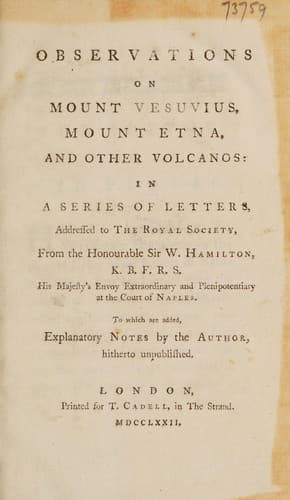
Observations on Mount Vesuvius, Mount Etna, and Other VolcanosHamilton, William, Sir
Science
Observations on Mount Vesuvius, Mount Etna, and Other Volcanos
Hamilton, William, Sir
Etna, Mount (Italy) -- Early works to 1800; Vesuvius (Italy) -- Early works to 1800; Volcanoes -- Italy -- Early works to 1800
Such remarks as I have made on the eruptions of Mount Vesuvius, during
my residence at Naples, have been transmitted to the Royal Society, who
have done them more honour than they deserved. Many more might be made
upon this active Volcano, by a person who had leisure, a previous
knowledge of the natural history of the earth, a knowledge of chemistry,
and was practised in physical experiments, particularly those of
electricity[44]. I am convinced, that the smoak of Volcanos contains
always a portion of electrical matter; which is manifest at the time of
great eruptions, as is mentioned in my account of the great eruption of
Vesuvius in 1767. The peasants in the neighbourhood of my villa,
situated at the foot of Vesuvius, have assured me, that, during the
eruption last mentioned, they were more alarmed by the lightning and
balls of fire that fell about them with a crackling noise, than by the
lava and the usual attendants of an eruption. I find in all the accounts
of great eruptions mention made of this sort of lightning, which is
distinguished here by the name of _Ferilli_. Bracini, in his account of
the great one of Vesuvius in 1631, says, that the column of smoak, which
issued from its crater, went over near an hundred miles of country, and
that several men and beasts were struck dead by lightning, issuing from
this smoak in its course.
The nature of the noxious vapours, called here _mofete_, that are
usually set in motion by an eruption of the Volcano, and are then
manifest in the wells and subterraneous parts of its neighbourhood, seem
likewise to be little understood. From some experiments very lately
made, by the ingenious Dr. Nooth, on the _mofete_ of the Grotto del
Cane, it appears that all its known qualities and effects correspond
with those attributed to fixed air. Just before the eruption of 1767, a
vapour of this kind broke into the King's chapel at Portici, by which a
servant, opening the door of it, was struck down. About the same time,
as his Sicilian Majesty was shooting in a paddock near the palace, a dog
dropped down, as was supposed, in a fit; a boy going to take him up
dropped likewise; a person present, suspecting the accident to have
proceeded from a _mofete_, immediately dragged them both from the spot
where they lay, in doing which, he was himself sensible of the vapour;
the boy and the dog soon recovered. His Sicilian Majesty did me the
honour of informing me himself of this accident soon after it had
happened. I have met with these _mofetes_ often, when I have been making
my observations on the borders of Mount Vesuvius, particularly in
caverns, and once on the Solfaterra. The vapour affects the nostrils,
throat, and stomach, just as the spirit of hartshorn, or any strong
volatile salts; and would soon prove fatal, if you did not immediately
remove from it. Under the ancient city of Pompeii, the _mofetes_ are
very frequent and powerful, so that the excavations that are carrying on
Public-domain text, read in full here on John Shaqi.
Reviews
Reviews
No reviews yet
Be the first to share your thoughts on this work.
Join the Discussion
Join the discussion
Sign in to leave a comment or review.
Sign InorCreate an account