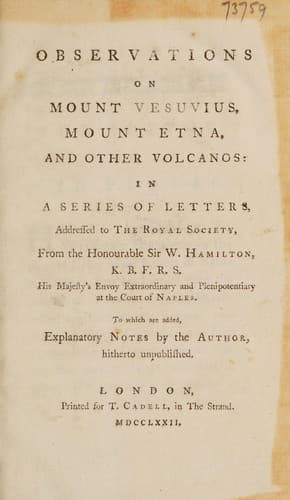
Observations on Mount Vesuvius, Mount Etna, and Other Volcanos — John Shaqi
Observations on Mount Vesuvius, Mount Etna, and Other VolcanosHamilton, William, Sir
Science
Observations on Mount Vesuvius, Mount Etna, and Other Volcanos
Hamilton, William, Sir
Etna, Mount (Italy) -- Early works to 1800; Vesuvius (Italy) -- Early works to 1800; Volcanoes -- Italy -- Early works to 1800
there are often interrupted by them; at all times _mofetes_ are to be
met with under ancient lavas of Vesuvius, particularly those of the
great eruption of 1631. In Serao's account of the eruption of 1737, and
in the chapter upon _mofetes_, he has recorded several curious
experiments relative to this phaenomenon. The Canonico Recupero, who, as
I mentioned to you in a former letter, is watching the operations of
Mount Etna, has just informed me, that a very powerful _mofete_ has
lately manifested itself in the neighbourhood of Etna; and that he
found, near the spot from whence it rises, animals, birds, and insects,
dead, and the stronger sort of shrubs blasted, whilst the grass and the
tenderer plants did not seem to be affected. The circumstance of this
_mofete_, added to that of the frequent earthquakes felt lately at
Rhegio and Messina, makes it probable that an eruption of Mount Etna is
at hand.
I am alarmed at the length of this letter. By endeavouring to make
myself clearly understood, I have been led to make, what I thought,
necessary digressions. I must therefore beg of your goodness, that,
should you find this memoir, in its present state, too tedious (which I
greatly apprehend) to be presented to our respectable Society, you will
make only such extracts from it as you shall think will be most
agreeable and interesting. I am,
SIR,
With great truth and regard,
Your most obedient
humble servant,
W. HAMILTON.
[Illustration: _Plate VI._]
REFERENCES to the MAP,
[Plate VI.]
1. Naples.
2. Portici.
3. Resina, under which Herculaneum is buried.
4. Torre del Greco.
5. Hermitage, at which travellers usually rest, in their way up
Mount Vesuvius.
6. St. Angelo, a convent of Calmaldolese, situated upon a cone of
a mountain formed by an ancient explosion.
7. Cones formed by the eruption of 1760, and lava that ran from
them almost into the sea.
8. Mount Vesuvius and Somma.
9. Village of Somma.
10. The convent of the Madona del Arco, under which lavas have
been found at 300 feet depth, and which must have proceeded
from the mountain of Somma, when an active Volcano.
11. Ottaiano.
12. Torre del Annunziata.
13. Castel a Mare, near which the ancient town of Stabia is
buried, and where Pliny the elder lost his life.
14. Vico.
15. Sorrento, and the plain formed evidently by subterraneous
fire.
16. Massa.
17. Island of Caprea.
18. The Grotto of Pausilipo, cut through the mountain anciently,
to make a road from Naples to Puzzole.
19. Point of Pausilipo.
20. The Gaiola, where there are ruins of ancient buildings,
supposed to have belonged to Lucullus.
21. The island of Nisida, evidently formed by explosion.
22. The Lazaret.
23. The Bagnoli.
24. Puzzole, or Pozzuolo.
Public-domain text, read in full here on John Shaqi.
Reviews
Reviews
No reviews yet
Be the first to share your thoughts on this work.
Join the Discussion
Join the discussion
Sign in to leave a comment or review.
Sign InorCreate an account