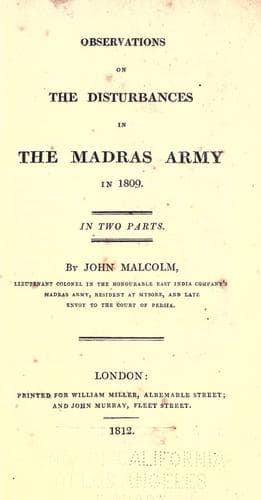
Observations on the Disturbances in the Madras Army in 1809Malcolm, John
History
Observations on the Disturbances in the Madras Army in 1809
Malcolm, John
India. Army -- History; Malcolm, John, 1769-1833
The force at Hyderabad continued but a short period in a state of
resistance; and they committed no act of violence. The impression
which Colonel Close's effort (though unsuccessful at the moment) had
made upon both the minds of European officers and natives, the effect
produced by the perusal of an order issued by Lord Minto on the 20th
of July, and the knowledge that his lordship was hourly expected at
Madras, deprived rebellion of its chief motive--personal hatred to
Sir George Barlow. And these circumstances, aided by the unremitted
conciliatory efforts of the commanding officer, Colonel Montresor,
and the Resident, Captain Sydenham, made a complete change in the
sentiments of this corps, who upon the 12th of August signed the
test: and as their example encouraged many corps of the army, but
particularly those that formed the garrison of Seringapatam, in a
rebellious resistance to Government, their defection from the cause
put an end to this horrid and unnatural contest: and Lord Minto, who
arrived a few days after this event, found a complete and unreserved
submission to his authority. Had he arrived a month earlier, he would
have saved an army from disgrace and ruin: and as it was, it is not
easy to calculate the good which his presence effected: but it is not
unreasonable to conclude, that the report even of his approach went
farther to terminate the partial rebellion that had occurred, than all
the violence of the Madras Government.
The whole of these proceedings ought to be held in constant remembrance
by all parties in future times. "As they have existed for our shame,
they ought to exist for our instruction[28]."
To the officers of the Indian army they are awfully instructive. They
will not consider a few remarks on the nature of that instruction as
unbecoming in one who has served with them for near twenty-eight years;
who came among them in childhood; whose fortune and character have been
acquired with them; whose affection and pride are, and always must be,
deeply interested in their reputation.
If they dispassionately consider these events, they will clearly
perceive the danger of the first approaches towards a military
combination, intended only to solicit a Government, but necessarily
tending to influence, to overawe, and to coerce it. The purity of
intention affords no security against this progress. Men who deliberate
and confederate with arms in their hands soon become impatient of the
slow course of redress by regular means. Indignant at refusals, or even
delays, which they deem unjust, they become familiar with the dangerous
idea of seeking more summary justice. They assemble, their passions are
kindled by communication of grievances, they are emboldened by a sense
of collective strength, and proceed from solicitations to threats,
disguised (from the great majority of those that use them) in the form
of predictions apparently flowing from an anxious desire to avert the
evils foretold.
Public-domain text, read in full here on John Shaqi.
Reviews
Reviews
No reviews yet
Be the first to share your thoughts on this work.
Join the Discussion
Join the discussion
Sign in to leave a comment or review.
Sign InorCreate an account