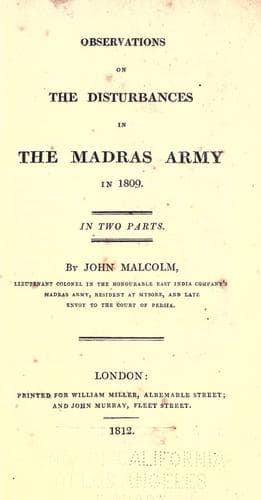
Observations on the Disturbances in the Madras Army in 1809Malcolm, John
History
Observations on the Disturbances in the Madras Army in 1809
Malcolm, John
India. Army -- History; Malcolm, John, 1769-1833
Such addresses bring upon them censure and harsh imputation, which
they resent the more because they are not yet distinctly conscious
of intentions which merit them. Their language becomes still more
indecorous and violent; and some of their most conspicuous leaders are
punished. They have then unhappily placed themselves in a situation
where they are pushed forward on the road of guilt by the most virtuous
impulses of the human heart--fidelity towards each other, honourable
attachment to the distinguished members of their body become sufferers
in their cause, and indignation against what they (under the influence
of self-delusion) regard as insupportable tyranny, impel them onward
with irresistible force. Youth, with all its generous feelings, its
inexperience and its impetuosity, assumes the lead in their councils.
The prudent and the moderate are either banished as traitors, or
compelled to be instruments of the more inconsiderate and daring. They
find that they have forfeited all expectation of a tolerable pardon.
They see no hopes of safety but in victory; and they are hurried on by
fear and despair, as well as anger and resentment, to rebellion.
Thus terminates in guilt the progress of men who began with innocence
and honour; and of whom each, if the termination had been foretold even
when he was far advanced in impropriety, might with sincerity have
exclaimed, "_Is thy servant a dog, that he should do this great thing?_"
Any event of such a rebellion would be most unfortunate to those
engaged in it, but success would be the greater misfortune, and indeed
the most severe punishment with which the justice of Providence could
visit their guilt.
Success would every where be a dreadful calamity to a body of
British officers betrayed into military rebellion against the
civil authorities of their country. Their success would be the
destruction of every source and guard of their own security, and of
every thing of which the defence peculiarly ennobles and endears the
profession of arms to a British soldier. In India, however, this
misfortune of success would have very bitter aggravations. As soon
as British officers had oppressed the lawful authority, they would
quickly discover what, in the tumult of dissension, their passions
had concealed from them, that they had, though unknowingly, raised
their arms against their country, which must espouse the cause of her
delegated authorities[29]. They would thus be proscribed and exiled by
a country, the hope of revisiting which is the basis of every plan and
expectation of their lives.
Public-domain text, read in full here on John Shaqi.
Reviews
Reviews
No reviews yet
Be the first to share your thoughts on this work.
Join the Discussion
Join the discussion
Sign in to leave a comment or review.
Sign InorCreate an account