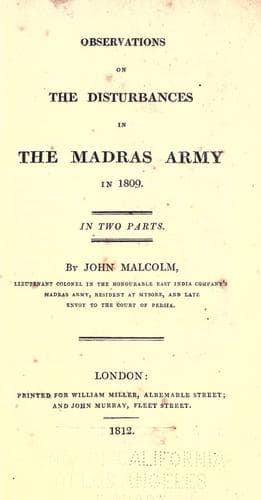
Observations on the Disturbances in the Madras Army in 1809Malcolm, John
History
Observations on the Disturbances in the Madras Army in 1809
Malcolm, John
India. Army -- History; Malcolm, John, 1769-1833
In the circumstances of the case, and after the restoration of the
surviving officer by his superiors, it is very mild language to call
this suspension an act of very doubtful justice. And it is most
certain, that an act of authority so harsh, and of such doubtful
justice, against officers who had such a fair appearance of mere
military obedience, and whose very fault, if they had one, must have
sprung from a zeal for military privileges, was of a nature to vibrate
through every nerve of an army. When the Government once did an act
which made two officers of rank at least appear to suffer unjustly for
the army, they entirely changed the character of the disputes. They
drove the generosity, honour, and justice of the army into rebellion.
They supplied the discontented with the colour of right, without which
no leaders are ever able to seduce multitudes to resistance. They
exalted pecuniary grievances into the feelings of generous sympathy and
wounded honour. They made it be thought disgraceful to abstain from
taking a part in a combination to prevent injustice. The moderate, the
disinterested, the loyal, even the timid and circumspect, were forced
into opposition,--by shame, by fear, by sympathy, by that tumultuous
combination of causes, generous and mean, which recruit the ranks of
insurgents, and change the murmurs of a few into the mutinous clamour
of the many. Whatever the evil intentions of a few may be, it is
always an act of real or supposed injustice which throws the multitude
into the hands of the ill-affected leaders. Before the suspension there
existed only discontents; after it, general disaffection, conspiracy,
and sedition.
The necessity of vesting the power of dismissing or suspending officers
in the Government will never be questioned by thinking men: but when it
is considered, that the operation of the general orders of the 1st of
May was, considering the rank and number of the suspended officers, not
a much less exertion of authority than if his Majesty were to strike a
tenth part of his general officers out of the list of the army, it will
not be wondered that this example of the precarious and degraded tenure
by which military rank was held, should have diffused universal dismay,
and reinforced resentment by despair.
The dispassionate observer, after remarking with wonder that every
expedient was omitted or rejected which could detach the misguided
from the ill-affected, or open a creditable retreat for the penitent,
will pause before the sword was drawn, to consider whether general
submission would then have been too dearly purchased by an amnesty
which should not have excluded from hope even the officers suspended on
the 1st of May.
Public-domain text, read in full here on John Shaqi.
Reviews
Reviews
No reviews yet
Be the first to share your thoughts on this work.
Join the Discussion
Join the discussion
Sign in to leave a comment or review.
Sign InorCreate an account