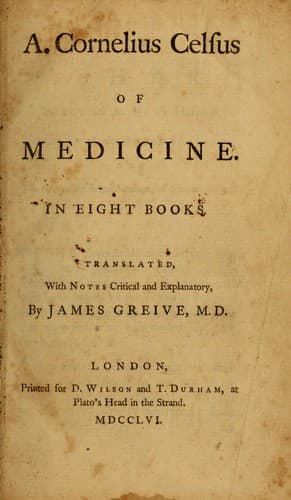
Of Medicine, in Eight BooksCelsus, Aulus Cornelius
History
Of Medicine, in Eight Books
Celsus, Aulus Cornelius
Medicine, Greek and Roman
A man, whose stomach is infirm, ought to read aloud, after reading to
walk, then to exercise himself with the ball or arms, or any other
kind, which agitates the superior parts; upon an empty stomach, not
to drink water, but hot wine; to take food twice a day, but in such
quantity, as he can easily concoct; to make use of small and austere
wine, and to take his drink after meat rather cold. The indications of
a weak stomach are paleness, leanness, pain in the præcordia, nausea,
involuntary vomiting, a pain of the head, when the stomach is empty:
where these signs are not found, the stomach is strong. And we are not
to believe our countrymen, who, when they are indisposed, and have
a strong inclination for wine or cold water, defend their luxury by
pretending the stomach does not do its office. But those that concoct
slowly, and whose præcordia on that account are inflated, or who, by
reason of any heat, are accustomed to be thirsty in the night-time,
before going to rest may drink two or three cyathi of wine through a
small pipe. It is good also against a slow concoction to read aloud,
then to walk, afterwards to anoint or bathe, to drink always cold wine,
and after meat to drink largely, but in the way I mentioned already by
a siphon: lastly, to conclude all the drinks with cold water. He, whose
food grows sour in his stomach, before he eats, should drink egelid
water, and vomit. But if the use of this should occasion a looseness,
whenever he is relieved of that complaint, he should by all means make
use of cold drinks.
CHAP. IX.
DIRECTIONS FOR THOSE THAT ARE LIABLE TO PAINS OF THE NERVES.
Public-domain text, read in full here on John Shaqi.
Reviews
Reviews
No reviews yet
Be the first to share your thoughts on this work.
Join the Discussion
Join the discussion
Sign in to leave a comment or review.
Sign InorCreate an account