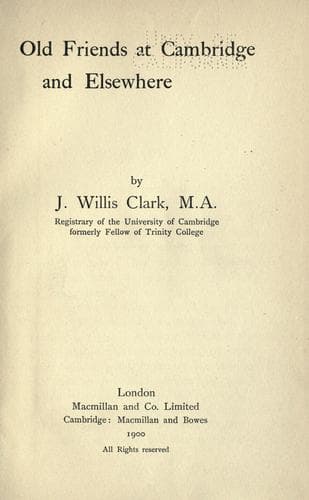
Old Friends at Cambridge and ElsewhereClark, John Willis
History
Old Friends at Cambridge and Elsewhere
Clark, John Willis
University of Cambridge -- History
‘High as my expectations were of it,’ he writes to Dr Schmitz, ‘it has
very much surpassed them all, and affords an earnest of something which
has never been done for the subject either in our own or any other
literature[61]’; and to Grote himself, when the publication of four
volumes had enabled him to form a maturer judgment, he not only used
stronger words of praise, but contrasted it with his own History in
terms which for generosity and sincerity can never be surpassed. After
alluding to ‘the great inferiority’ of his ‘own performance,’ he
concludes as follows: ‘I may well be satisfied with that measure of
temporary success and usefulness which has attended it, and can
unfeignedly rejoice that it will, for all highest purposes, be so
superseded[62].’ It would be beside our present purpose to attempt a
comparison of the relative merits of these two works, which, by a
curious coincidence, had been elaborated simultaneously. They have many
points of resemblance. Both originated in a desire to apply to the
history of Greece those principles of criticism which Niebuhr had
applied so successfully to the history of Rome; both were intended to
counteract the misrepresentations of Mitford; both were the result of
long and careful preparation. Grote has a decided advantage in point of
style; he writes vigorous, ‘newspaper’ English, as might be expected
from a successful pamphleteer; while Thirlwall’s periods are laboured
and somewhat wooden. Grote has infused animation into his work by being
always a partisan. We do not mean that he wilfully misrepresents facts;
he certainly does not; but he unconsciously finds ‘extenuating
circumstances’ for those with whom he sympathizes, and condemns
remorselessly those whose springs of action are alien to his own.
Thirlwall, on the contrary, holds the judicial balance with a firm hand.
In estimating character his serene intellect is never warped by
partisanship, or by a wish to present old facts under a new face; while
from his scholarship and critical power there is no appeal.
Public-domain text, read in full here on John Shaqi.
Reviews
Reviews
No reviews yet
Be the first to share your thoughts on this work.
Join the Discussion
Join the discussion
Sign in to leave a comment or review.
Sign InorCreate an account