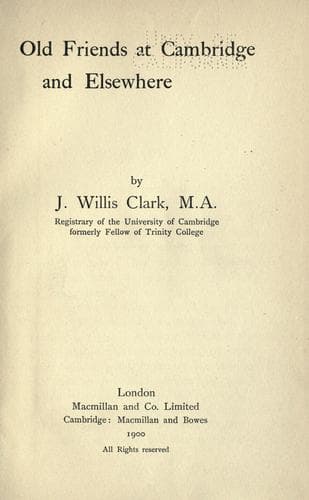
Old Friends at Cambridge and ElsewhereClark, John Willis
History
Old Friends at Cambridge and Elsewhere
Clark, John Willis
University of Cambridge -- History
Thirlwall’s life as a bishop did not differ much, at least in its
outward surroundings, from his life as a parish clergyman. The palace at
S. David’s having been allowed to fall to ruin, the Bishop is compelled
to live at Abergwili, a small village near Carmarthen, distant nearly
fifty miles from his cathedral. Most persons would have regretted the
isolation of such a position, but to Thirlwall the enforced solitude of
Abergwili was thoroughly congenial. There he could read, as he delighted
to do, ‘literally from morning till night.’ Except in summer time he
rarely quitted ‘Chaos,’ as he called his library, where books lined the
walls and shared with papers and letters the tables, chairs, and floor.
It is curious that a man with so orderly a mind should have had such
disorderly habits. His letters are full of references to lost papers;
and when offers to arrange his drawers were made he would answer
regretfully, ‘I can find nothing in them now, but if they were set to
rights for me I should certainly find nothing then.’ Books accompanied
him to his meals; and when he went out for a walk or a drive he read
steadily most of the time. He does not seem to have had any favourite
authors; he read eagerly new books in all languages and on all subjects.
We believe that he took no notes of what he read; but his singularly
powerful memory enabled him to seize all that he wanted, and, as may be
seen from the collection of his writings which is now before us, to
retain it until required for use. His charges, essays, and serious
correspondence reveal his mastery of theological literature, both past
and present; the charming _Letters to a Friend_ give us very pleasant
glimpses of the gentler side of his character. We find from them that he
took a keen interest in the general literature of England and the
Continent, whether in philosophy, science, history, biography, fiction,
poetry; and, as he and his young correspondent exchanged their
sentiments without restraint, we can enjoy to the full his criticisms,
now serious, now playful, on authors and their productions, his generous
appreciation of all that is noble in life or art. We must find room for
one passage on George Eliot’s last story, written in 1872, when he was
seventy-five years old.
‘I suppose you cannot have read _Middlemarch_, as you say nothing about
it. It stands quite alone. As one only just moistens one’s lips with an
exquisite liqueur to keep the taste as long as possible in one’s mouth,
I never read more than a single chapter of _Middlemarch_ in the evening,
dreading to come to the last, when I must wait two months for a renewal
of the pleasure. The depth of humour has certainly never been surpassed
in English literature. If there is ever a shade too much learning that
is Lewes’s fault[64].’
Public-domain text, read in full here on John Shaqi.
Reviews
Reviews
No reviews yet
Be the first to share your thoughts on this work.
Join the Discussion
Join the discussion
Sign in to leave a comment or review.
Sign InorCreate an account