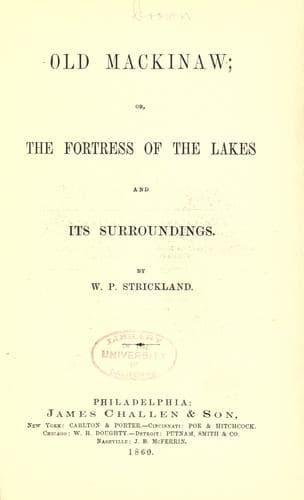
Old Mackinaw; Or, The Fortress of the Lakes and its SurroundingsStrickland, W. P. (William Peter)
History
Old Mackinaw; Or, The Fortress of the Lakes and its Surroundings
Strickland, W. P. (William Peter)
Great Lakes (North America); Mackinac Island (Mich. : Island) -- History; Michigan -- History
One who had resided upon the shores of Lake Superior for several
summers says, "Our attention has been directed to the fluctuations in
the level of its waters, and while we have failed to detect any ebb
and flow corresponding with the tidal action, we have on the other
hand noticed certain extraordinary swells, which appear to be
independent of the action of the sun and moon." The Jesuit Fathers in
1670-1, had their attention called to these extraordinary swells. In
their "Relations," they say, "We found at one time the motion of the
waters to be regular and at others extremely fluctuating. We have
noticed however, that at full moon and new moon, the tides change once
a day for eight or ten days, while during the remainder of the time
there is hardly any change perceptible. The currents set almost
invariably in one direction, namely toward Lake Michigan, and they
almost invariably set against the wind, sometimes with great force."
Mackenzie who wrote in 1789, relates a very curious phenomenon, which
occurred at Grand Portage, on Lake Superior, and for which no obvious
cause could be assigned. He says, "the water withdrew, leaving the
ground dry, which had never before been visible, the fall being equal
to four perpendicular feet, and rushing back with great velocity above
the common mark. It continued thus rising and falling for several
hours, gradually increasing until it stopped at its usual height."
Professor Mather, who observed the barometer at Copper Harbor during
the prevalence of one of these fluctuations, remarks, "As a general
thing, fluctuations in the barometer accompanied the fluctuations in
the level of the water, but sometimes the water level varied rapidly
in the harbor, while no such variations occurred in the barometer at
the place of observation. The variations in the level of the water may
be caused by varied barometric pressure of the air on the water,
either at the place of observation or at some distant points. A local
increased pressure of the atmosphere at the place of observation would
lower the water level, where there is a wide expanse of water; or a
diminished pressure, under the same circumstances, would cause the
water to rise above its usual level."
Public-domain text, read in full here on John Shaqi.
Reviews
Reviews
No reviews yet
Be the first to share your thoughts on this work.
Join the Discussion
Join the discussion
Sign in to leave a comment or review.
Sign InorCreate an account