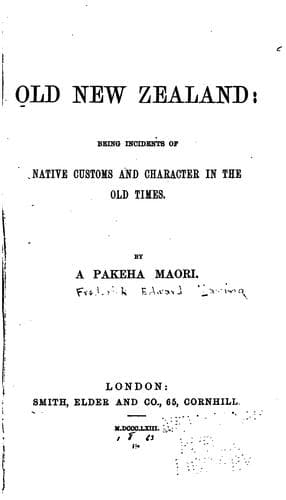
Old New Zealand: Being Incidents of Native Customs and Character in the Old TimesManing, Frederick Edward
History
Old New Zealand: Being Incidents of Native Customs and Character in the Old Times
Maning, Frederick Edward
Māori (New Zealand people); New Zealand -- Description and travel
Now, ladies, I call that a fairish good fight, considering no one is
killed on either side. I promise to be good in future and to keep the
peace, if people will let me; and indeed, I may as well mention, that
from that day to this I have never had occasion to explain again to a
Maori how it is that "every Englishman's house is his castle."
"Fair play is a jewel;" and I will here, as bound in honour to do,
declare that I have met amongst the natives with men who would be a
credit to any nation; men on whom nature had plainly stamped the mark
of "Noble," of the finest bodily form, quick and intelligent in mind,
polite and brave, and capable of the most self-sacrificing acts for the
good of others; patient, forbearing, and affectionate in their
families: in a word, gentlemen. These men were the more remarkable as
they had grown up surrounded by a set of circumstances of the most
unfavourable kind for the development of the qualities of which they
were possessed; and I have often looked on with admiration, when I have
seen them protesting against, and endeavouring to restrain some of, the
dreadful barbarities of their countrymen.
As for the Maori people in general, they are neither so good nor so bad
as their friends and enemies have painted them, and I suspect are
pretty much like what almost any other people would have become, if
subjected for ages to the same external circumstances. For ages they
have struggled against necessity in all its shapes. This has given to
them a remarkable greediness for gain in every visible and immediately
tangible form. It has even left its mark on their language. Without the
aid of iron the most trifling tool or utensil could only be procured by
an enormously disproportionate outlay of labour in its construction,
and, in consequence, it became precious to a degree scarcely
conceivable by people of civilized and wealthy countries. This great
value attached to personal property of all kinds, increased
proportionately the temptation to plunder; and where no law existed, or
could exist, of sufficient force to repress the inclination, every man,
as a natural consequence, became a soldier; if it were only for the
defence of his own property and that of those who were banded with
him--his tribe, or family.
Public-domain text, read in full here on John Shaqi.
Reviews
Reviews
No reviews yet
Be the first to share your thoughts on this work.
Elsewhere in the archive
Join the Discussion
Join the discussion
Sign in to leave a comment or review.
Sign InorCreate an account