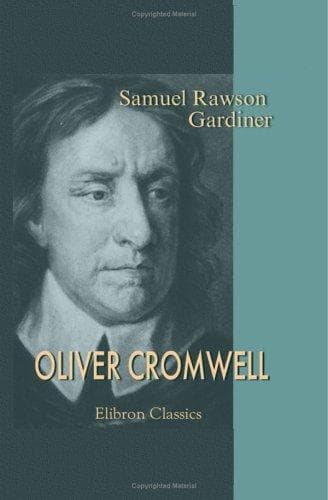
Cromwell, Oliver, 1599-1658; Great Britain -- History -- Commonwealth and Protectorate, 1649-1660
It was hard, indeed, in those days, to say where the face of authority
was to be found, and Cromwell was far from being able to solve the
question. The most innocent suggestion made by his opponents was that
the army must purge Parliament and declare the King responsible for
the ruin of the country. Goffe declared that it had been revealed to
him that the sin of the army lay in its tampering with God's enemies,
in other words, with Charles. Cromwell struck in with an expression of
distrust in personal revelations. He himself, he explained, was guided
by God's dispensations, that is to say, in more modern phrase, by the
requirements of the situation. He acknowledged that danger was to be
apprehended from the King and House of Lords, and that it was not his
intention 'to preserve the one or the other with a visible danger and
destruction to the people and the public interest'. On the other hand,
he refused to accept it as certain that God had determined to destroy
King and Lords, though he thought it probable that it was so. In the
end, the constitutional discussion was transferred to a committee.
For a right judgment of Cromwell's character and habits of procedure
no evidence exists of such importance as that which has been thus
summarised. Here at least is laid bare before us his reluctance to
abandon an untenable position, long after it has become clear to more
impatient spirits that it has become untenable. Yet his hesitation is
not based on any timorous reluctance to act. It arises from his keen
sense of the danger of any alternative policy, a sense which will be
overmastered as soon as action in one direction or the other becomes a
manifest necessity. On November 8, seeing that the Levellers were bent
on pushing forward their proposal of manhood suffrage, he obtained a
vote from the Army Council directing that both officers and Agitators
should be sent back to their regiments. There can be little doubt
that the danger was greater than was thus indicated, and that there
was truth in a story which charged the Levellers with intending, at
this time, to purge the Parliament and to bring the King to trial. On
the 11th, at all events, the brave but fanatical Colonel Harrison was
calling for the prosecution of the King, and on the same day Cromwell
sent to Whalley, who commanded the guard at Hampton Court, to provide
against any attempt on Charles's person. Similar warnings had reached
Charles himself, and on the evening of the same day he quietly made his
escape. On the 14th, after the failure of a scheme for the provision
of a vessel from Southampton to carry him to France, he reached
Carisbrooke, where the Governor of the Castle was Robert Hammond,
Cromwell's cousin. Cromwell's first task was to ensure the discipline
of the army. His persistent efforts to keep up negotiation with the
King had exposed him to the distrust of the Levellers, and it is said
that some of them had resolved to murder him in his bed. There was no
time to be lost.
Public-domain text, read in full here on John Shaqi.
Reviews
Reviews
No reviews yet
Be the first to share your thoughts on this work.
Join the Discussion
Join the discussion
Sign in to leave a comment or review.
Sign InorCreate an account