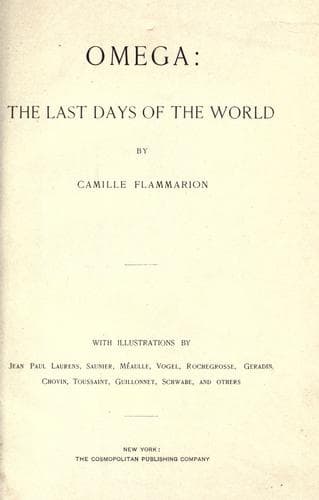
Omega: The Last days of the WorldFlammarion, Camille
Philosophy
Omega: The Last days of the World
Flammarion, Camille
End of the world -- Fiction; Science fiction
“Yes, doubtless, gentlemen,” she continued, “the water will grow less,
and, perhaps, in the end totally disappear; yet, it is not this lack of
water which in itself will bring about the end of things, but its
climatic consequences. The decrease in the amount of aqueous vapor in
the atmosphere will lead to a general lowering of the temperature, and
humanity will perish _with cold_.
“I need inform no one here that the atmosphere we breathe is composed of
seventy-nine per cent. of nitrogen and twenty per cent. of oxygen, and
that of the remaining one per cent. about one-half is aqueous vapor and
three ten-thousandths is carbonic acid, the remainder being ozone, or
electrified oxygen, ammonia, hydrogen and a few other gases, in
exceedingly small quantities. Nitrogen and oxygen, then, form
ninety-nine per cent. of the atmosphere, and the vapor of water one-half
the remainder.
“But, gentlemen, from the point of view of vegetable and animal life,
this half of one per cent. of aqueous vapor is of supreme importance,
and so far as temperature and climate are concerned, I do not hesitate
to assert that it is more essential than all the rest of the atmosphere.
“The heat waves, coming from the sun to the earth, which warm the soil
and are thence returned and scattered through the atmosphere into space,
in their passage through the air meet with the oxygen and nitrogen atoms
and with the molecules of aqueous vapor. These molecules are so thinly
scattered (for they occupy but the hundredth part of the space occupied
by the others), that one might infer that the retention of any heat
whatever is due rather to the nitrogen and oxygen than to the aqueous
vapor. Indeed, if we consider the atoms alone, we find two hundred
oxygen and nitrogen atoms for one of aqueous vapor. Well, this one atom
has eighty times more energy, more effective power to retain radiant
heat, than the two hundred others; consequently, a molecule of the vapor
of water is 16,000 times more effective than a molecule of dry air, in
absorbing and in radiating heat—for these two properties are
reciprocally proportional.
Public-domain text, read in full here on John Shaqi.
Reviews
Reviews
No reviews yet
Be the first to share your thoughts on this work.
Join the Discussion
Join the discussion
Sign in to leave a comment or review.
Sign InorCreate an account