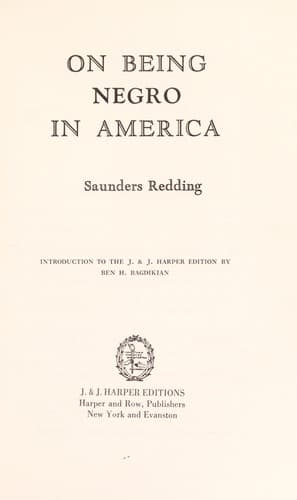
On Being Negro in AmericaRedding, J. Saunders (Jay Saunders)
General
On Being Negro in America
Redding, J. Saunders (Jay Saunders)
African Americans -- Race identity; Redding, J. Saunders (Jay Saunders), 1906-1988; United States -- Race relations
“The claim that there is nothing in the color of the skin from the point
of view of political ethics is a great sophism. A black skin means
membership in a race of men which has never of itself succeeded in
subjecting passion to reason, has never, therefore, created any
civilization of any kind. To put such a race of men in possession of a
‘state’ government in a system of federal government is to trust them
with the development of political and legal civilization upon the most
important subjects of human life.... There is something natural in the
subordination of an inferior race to a superior race, even to the point
of the enslavement of the inferior race.... It is the white man’s
mission, his duty and his right, to hold the reins of political power in
his own hands for the civilization of the world and the welfare of
mankind.”[13]
Ignorance and willful distortion of the facts of American life and
history in regard to the Negro’s role have set the Negro scholar what up
to now has been a thankless task. In pure self-defense he has had to try
to set the record straight. The first Negro professional writer in
America, William Wells Brown, was primarily a historian. Negro scholars
have written thousands of dissertations, theses, monographs, articles,
essays and books in a gigantic effort to correct the multiple injuries
done the race by white writers. Five great collections—at Howard,
Hampton, Fisk, Yale, and the Harlem Branch of the New York Public
Library—house thousands of volumes and hundreds of magazine and
newspaper files, but few except Negroes bother to disturb their dust.
Whites show little interest in this Negroana. They seem to feel that
they do not need to know about the Negro; they seem to feel that the
basic truths about him were established long ago. Even the primary
source material on him whom white America calls the greatest Negro
American, him whom they have enshrined in the Hall of Fame and about
whom they have written ten million words—even the primary source
material on Booker Washington—some twenty thousand letters and other
papers—remain scarcely touched and certainly unexplored in the Library
of Congress, though the Harvard University Press published an erudite
and “definitive biography” of the man in 1949.
Public-domain text, read in full here on John Shaqi.
Reviews
Reviews
No reviews yet
Be the first to share your thoughts on this work.
Join the Discussion
Join the discussion
Sign in to leave a comment or review.
Sign InorCreate an account