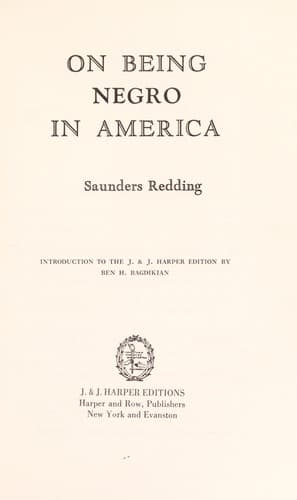
On Being Negro in AmericaRedding, J. Saunders (Jay Saunders)
General
On Being Negro in America
Redding, J. Saunders (Jay Saunders)
African Americans -- Race identity; Redding, J. Saunders (Jay Saunders), 1906-1988; United States -- Race relations
Compulsively dissociated from the American tradition, the Negro on the
upper level has had to maintain the pretense of possessing what he is in
fact denied. He has had no choice but this. He has not been free to
realize his ideals or to strive to be what the American tradition has
made him wish to be. Paul Lawrence Dunbar, probably the most popular
American poet at the turn of the century, did not wish to write “jingles
in a broken tongue,” but he was Negro and as a Negro he had to write
dialect or else have no hearing as a poet. James Weldon Johnson did not
wish to compose those “darky” lyrics and “coon songs” for Williams and
Walker’s and his own brother Rosamond’s shows—nor did Williams and
Walker and Rosamond Johnson wish to sing them and caper to them. But how
else were they to find outlets for their creative urges, when all of the
more congenial and less particularized were dammed up against them?
DuBois had ideas for a career other than the one he was compelled to
follow. “Had it not been for the race problem early thrust upon me and
enveloping me,” he wrote in _Dusk of Dawn_, “I should have probably been
an unquestioning worshiper at the shrine of the social order and
economic development into which I was born.... What was wrong was that I
and people like me and thousands of others who might have my ability and
aspiration, were refused permission to be a part of this world. It was
as though moving on a rushing express, my main thought was as to the
relations I had to other passengers on the express, and not to its rate
of speed and its destination.... My attention from the first was
focused ... upon the problem of the admission of my people into the
freedom of democracy.”[12]
The dissociation of the Negro from the American tradition and the lack
of knowledge of the Negro on the historical level are certainly in part
the fault of social commentators and historians and social scholars. The
historians particularly have been guilty of almost complete silence,
like William A. Dunning; or of faulty investigation, like James Ford
Rhodes; or of misinterpretation of the facts, like Ulrich Philips and W.
E. Woodward; or of propaganda, like William E. Dodd and Jesse Carpenter;
or of frank and determined anti-Negro bias, like dozens, major and
minor, including Claude Bowers, James Truslow Adams, and John W.
Burgess—the last of whom, by his prestige as a faculty member at
Columbia University, gave scholarly sanction to prejudice. He wrote as
follows:
Public-domain text, read in full here on John Shaqi.
Reviews
Reviews
No reviews yet
Be the first to share your thoughts on this work.
Join the Discussion
Join the discussion
Sign in to leave a comment or review.
Sign InorCreate an account