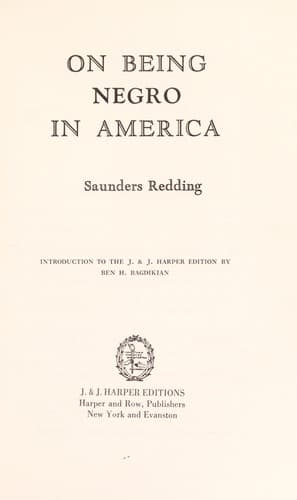
On Being Negro in AmericaRedding, J. Saunders (Jay Saunders)
General
On Being Negro in America
Redding, J. Saunders (Jay Saunders)
African Americans -- Race identity; Redding, J. Saunders (Jay Saunders), 1906-1988; United States -- Race relations
But there are limits to what even knowledge can accomplish, as any
psychologist will tell you. Knowledge alone is not enough to redeem life
from folly and to save men from despair. If it ever was, it is no longer
valid to assume that learning’s supreme glory is in the safeguarding of
humanity, the dispelling of prejudice, and the achieving of those moral
values that are said to have inspired men of other ages. Perhaps I am
deeply pessimistic, but I simply cannot believe that if only people knew
enough of the what, the why and the how, all would be right with the
world. Knowledge does not ensure moral behavior; it all too willingly
puts itself at the service of despotism and inhumanity. I suppose that
what is lacking in our modern learning and among our modern learned is a
sense that morality is the product of human experience—that it comes,
anciently out of a wisdom we have forgotten, from a realization of the
character of human life.
Certainly the moralistic approach to human relations in general and to
race relations in particular in America has failed so consistently that
one mentions this approach with embarrassment and reluctance. It is
considered namby-pamby, pusillanimous, Uncle-Tomish. Few, even of the
ministers of the gospel, appeal to nobility and virtue and goodness any
more, except as these qualities seem disingenuously to be connected with
“practical concerns.” We no longer think of great men as being great in
those virtuous qualities to which former and simpler ages subscribed.
Those moral excellencies—love, honor, truth—seem to many ordinary people
“a long way removed from our normal affairs.” Great men today are
“practical-minded,” “realistic” and “public-spirited,” and none of these
attributes, I take it, is necessarily virtuous. To be trite about it,
any one of them can cover a multitude of evils. The realistic attitude
has been the excuse for innumerable travesties of human rights; in the
name of public spirit heinous crimes have been committed against the
dignity of man; and too many politicians and diplomats have made
practical-mindedness the inviolable sanction for the suppression of the
worthy ambitions of the powerless.
Public-domain text, read in full here on John Shaqi.
Reviews
Reviews
No reviews yet
Be the first to share your thoughts on this work.
Join the Discussion
Join the discussion
Sign in to leave a comment or review.
Sign InorCreate an account