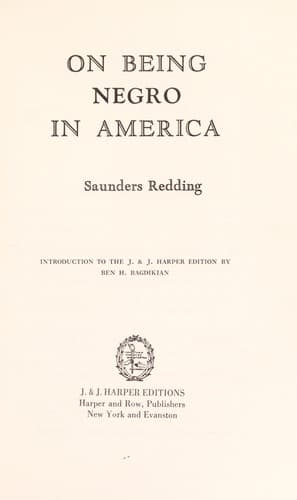
On Being Negro in AmericaRedding, J. Saunders (Jay Saunders)
General
On Being Negro in America
Redding, J. Saunders (Jay Saunders)
African Americans -- Race identity; Redding, J. Saunders (Jay Saunders), 1906-1988; United States -- Race relations
I do not know how long I have held both God and the Christian religion
in some doubt, though it must have been since my teens. Nor do I know
exactly how this came about. My father was (and is) very religious, of
great and clear and unbending faith. My mother was less so, but the
family went regularly to church, where we were all active, and I used
occasionally to see my mother so deeply touched by a religious feeling
that she could not keep back the tears. What inspired it in that chill
atmosphere it is impossible to say. I can only think that it came as a
result of some very personal communion with God, established perhaps by
a random thought, a word, or a certain slant of light through the yellow
and rose and purple windows. There was never any shouting or “getting
happy” among us, or in our church; none of that ecstatic abandon that
set men and women jumping and dancing and screaming in the aisles. After
the northward migration following the First World War, a few people who
may have had a natural tendency to such transports found their way to
our church, but they were frustrated by the mechanical expertness of the
uninspired sermons, the formalized prayers, and by the choirmaster’s
preference for hymns translated from fifteenth-century Latin. Never did
I hear a spiritual sung in our church, and only rarely a common-meter
Calvinist hymn.
Sometime during my teens I became aware that for most Negroes God was a
great deal more than a spirit to be worshiped on Sundays. He had a
terrifying immediacy as material provider and protector. Once a group of
us teen-agers went on a Sunday evening (our own church worshiped only in
the morning) to a mission church deep in the Bridge District where the
Negro population was concentrated. We went to mock, as some of us had
heard our parents do, at the malapropisms of the illiterate minister and
his ignorant flock, the crazy singing and shouting, and the uninhibited
behavior of members in religious ecstasy. We did not remain to pray, but
I was struck by what I saw and heard, and afterward my natural curiosity
led me to go occasionally alone. The service did not resemble, either in
ritual or content (both of which were created spontaneously), the
service to which I was used. Any member of the church could stand up and
pray. A whole evening might be given over to these impulsive outbursts.
The prayers impressed me with their concreteness, their concern for the
everyday. I heard one distraught mother, whose daughter evidently was
sitting beside her, beseech God: “Now here’s Idabelle, an’ she’s gone
and got herself bigged, an’ I’m askin’ you, God, to make the young
rascal who done it marry her. His name’s Herbie Washington, an’ he stays
on the street nex’ to me.” They prayed for bread, not in a general,
symbolic “give us this day our daily bread” sense, but for specific
bread and meat for specific occasions. “Aunt Callie Black’s laying up
there sick, Lord, an’ when I seen her, she tol’ me her mouth was
Public-domain text, read in full here on John Shaqi.
Reviews
Reviews
No reviews yet
Be the first to share your thoughts on this work.
Join the Discussion
Join the discussion
Sign in to leave a comment or review.
Sign InorCreate an account