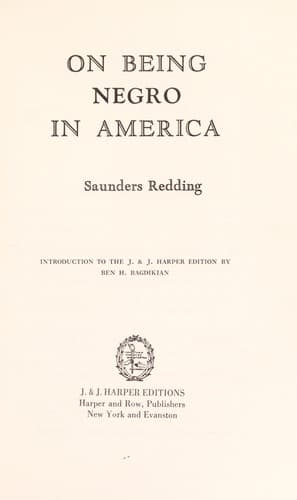
On Being Negro in AmericaRedding, J. Saunders (Jay Saunders)
General
On Being Negro in America
Redding, J. Saunders (Jay Saunders)
African Americans -- Race identity; Redding, J. Saunders (Jay Saunders), 1906-1988; United States -- Race relations
Such assertions were almost daily fare. It was not hard to find support
for them. I could see that most Negroes were poor and ignorant and
inferior. Every year on the last Sunday in August one of the Negro
religious denominations held a “quarterly meeting” in my home town.
People from a half dozen states poured in the day before and roamed the
streets all night, or slept anywhere they could—on the courthouse lawn,
in the wagons and trucks that brought them, in alleys and doorways. But
on the Sunday, what excitement! What noisy exuberance! Six city blocks,
just below the main street, were inundated with the germinal tide of
their living. Preachers exhorted; food vendors shouted; choirs sang;
bands played; lost children bawled; city prostitutes pushed brazenly for
trade among the young men from the country; people prayed and went into
transports.
I do not know when I began to notice the white people. I suppose they
had always been there. But along in my fourteenth or fifteenth year, I
suddenly seemed to see them. Small phalanxes of them always seemed to be
pushing or imperiously demanding passage through the crowds that fell
away before them like grain before a scythe. The white people sneered—or
so it seemed to me—and took pictures and made derisive comments. They
looked down in laughing contempt from the windows, balconies and roofs
of the buildings that lined the street. They came, also from miles
around, to watch the show, not to be a part of it. I realized with deep
shame that what the Negroes did on this holy day made a clowns’ circus
for the whites. The Negroes’ God made fools of them. Worship and
religiosity were things to be mocked and scorned, for they stamped the
Negro as inferior.
There must have been many vague progressions of thought and many
gradations of emotion between the premise and the conclusion. However
little I was aware of them, my nerves, muscles and brain—conditioned by
a thousand random and forgotten experiences—must have prepared me to
accept the conclusion without outrage and shock. I simply rejected
religion. I rejected God. Not my instincts, but my deepest feelings
revolted compulsively—not because I was I, a sort of neutral human stuff
reacting directly to experience, but because I was Negro. It is hard to
make it clear; but there were two people sharing my physical existence
and tearing me apart. One, I suppose, was the actual self which I wanted
to protect and yet which I seemed to hate with a consuming hatred; and
the other was the ideal self which tried compulsively to shape the
actual self away from all that Negroes seemed to be. At what emotional
and psychic cost this deep emotional conflict went on within me I do not
know. It was years before I understood that what I had wanted then was
to be white.
Public-domain text, read in full here on John Shaqi.
Reviews
Reviews
No reviews yet
Be the first to share your thoughts on this work.
Join the Discussion
Join the discussion
Sign in to leave a comment or review.
Sign InorCreate an account