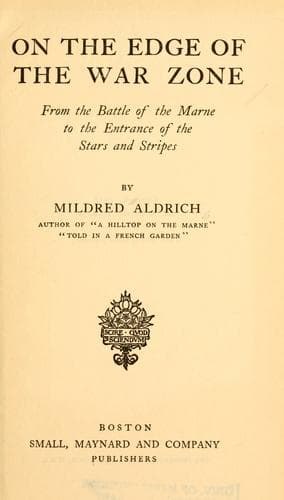
On the Edge of the War Zone: From the Battle of the Marne to the Entrance of the Stars and StripesAldrich, Mildred
History
On the Edge of the War Zone: From the Battle of the Marne to the Entrance of the Stars and Stripes
Aldrich, Mildred
World War, 1914-1918 -- Personal narratives
I learned at the Embassy, where the military attaché had consulted
the Ministry of War, that an arrangement was to be made later
regarding foreigners, and that we were to be provided with a special
book which, while it would not allow us to circulate freely, would give
us the right to demand a permission--and get it if the military
authorities chose. No great change that.
The visit served little purpose except to show me a sad-looking Paris
and make me rejoice to get back.
Now that the days are so short, and it is dark at four o'clock, Paris is
almost unrecognizable. With shop-shutters closed, tramway windows
curtained, very few street-lights--none at all on short streets--no
visible lights in houses, the city looks dead. You 'd have to see it to
realize what it is like.
The weather was dull, damp, the cold penetrating, and the
atmosphere depressing, and so was the conversation. It is better
here on the hilltop, even though, now and then, we hear the guns.
Coming back from Paris there were almost no lights on the platforms
at the railway stations, and all the coaches had their curtains drawn.
At the station at Esbly the same situation--a few lights, very low, on
the main platform, and absolutely none on the platform where I took
the narrow-gauge for Couilly. I went stumbling, in absolute blackness,
across the main track, and literally felt my way along the little train to
find a door to my coach. If it had not been for the one lamp on my
little cart waiting in the road, I could not have seen where the exit at
Couilly was. It was not gay, and it was far from gay climbing the long
hill, with the feeble rays of that one lamp to light the blackness.
Luckily Ninette knows the road in the dark.
In the early days of the war it used to be amusing in the train, as
everyone talked, and the talk was good. Those days are passed.
With the now famous order pasted on every window:
Taisez-vous! Méfiez-vous.
Les oreilles ennemies vous écoutent
no one says a word. I came back from Paris with half a dozen officers
in the compartment. Each one, as he entered, brought his hand to
salute, and sat down, without a word. They did not even look at one
another. It is one of the most marked changes in attitude that I have
seen since the war. It is right. We were all getting too talkative, but it
takes away the one charm there was in going to Paris. I've had no
adventures since I wrote to you Christmas Day, although we did
have, a few days after that, five minutes of excitement.
Public-domain text, read in full here on John Shaqi.
Reviews
Reviews
No reviews yet
Be the first to share your thoughts on this work.
Elsewhere in the archive
Join the Discussion
Join the discussion
Sign in to leave a comment or review.
Sign InorCreate an account