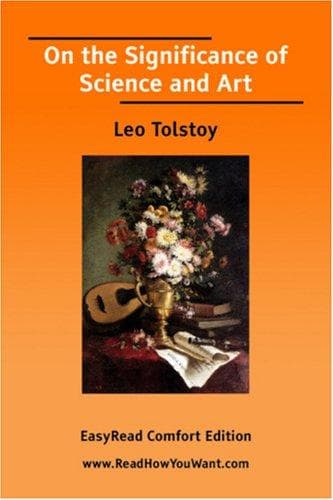
On the Significance of Science and ArtTolstoy, Leo, graf
Philosophy
On the Significance of Science and Art
Tolstoy, Leo, graf
Art and science; Literature; Philosophy; Tolstoy, Leo, graf, 1828-1910 -- Philosophy
It is the same with the _starosta_ [village elder], the machinist, the
writer, the learned man. To us, with our corrupt conception of things,
it seems, that if a steward has been relegated to the position of a
peasant by his master, or if a minister has been sent to the colonies, he
has been chastised, he has been ill-treated. But in reality a benefit
has been conferred on him; that is to say, his special, hard labor has
been changed into a cheerful rotation of labor. In a naturally
constituted society, this is quite otherwise. I know of one community
where the people supported themselves. One of the members of this
society was better educated than the rest; and they called upon him to
read, so that he was obliged to prepare himself during the day, in order
that he might read in the evening. This he did gladly, feeling that he
was useful to others, and that he was performing a good deed. But he
grew weary of exclusively intellectual work, and his health suffered from
it. The members of the community took pity on him, and requested him to
go to work in the fields.
For men who regard labor as the substance and the joy of life, the basis,
the foundation of life will always be the struggle with nature,--labor
both agricultural and mechanical, and intellectual, and the establishment
of communion between men. Departure from one or from many of these
varieties of labor, and the adoption of special labor, will then only
occur when the man possessed of a special branch, and loving this work,
and knowing that he can perform it better than others, sacrifices his own
profit for the satisfaction of the direct demands made upon him. Only on
condition of such a view of labor, and of the natural division of labor
arising from it, is that curse which is laid upon our idea of labor
abrogated, and does every sort of work becomes always a joy; because a
man will either perform that labor which is undoubtedly useful and
joyous, and not dull, or he will possess the consciousness of
self-abnegation in the fulfilment of more difficult and restricted toil,
which he exercises for the good of others.
Public-domain text, read in full here on John Shaqi.
Reviews
Reviews
No reviews yet
Be the first to share your thoughts on this work.
Elsewhere in the archive
Join the Discussion
Join the discussion
Sign in to leave a comment or review.
Sign InorCreate an account