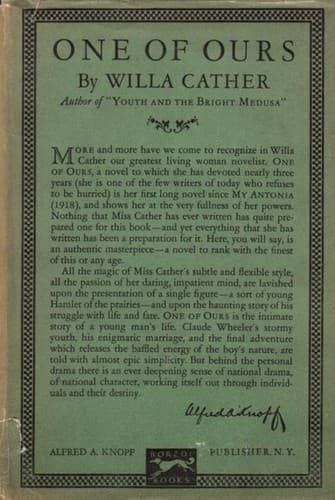
Farm life -- Fiction; Nebraska -- Fiction; Soldiers -- Fiction; War stories; World War, 1914-1918 -- Fiction
Claude dreaded the inactivity of the winter, to which the farmer
usually looks forward with pleasure. He made the Thanksgiving
football game a pretext for going up to Lincoln,--went intending
to stay three days and stayed ten. The first night, when he
knocked at the glass door of the Erlichs' sitting-room and took
them by surprise, he thought he could never go back to the farm.
Approaching the house on that clear, frosty autumn evening,
crossing the lawn strewn with crackling dry leaves, he told
himself that he must not hope to find things the same. But they
were the same. The boys were lounging and smoking about the
square table with the lamp on it, and Mrs. Erlich was at the
piano, playing one of Mendelssohn's "Songs Without Words." When
he knocked, Otto opened the door and called:
"A surprise for you, Mother! Guess who's here."
What a welcome she gave him, and how much she had to tell him!
While they were all talking at once, Henry, the oldest son, came
downstairs dressed for a Colonial ball, with satin breeches and
stockings and a sword. His brothers began to point out the
inaccuracies of his costume, telling him that he couldn't
possibly call himself a French emigré unless he wore a powdered
wig. Henry took a book of memoirs from the shelf to prove to them
that at the time when the French emigrés were coming to
Philadelphia, powder was going out of fashion.
During this discussion, Mrs. Erlich drew Claude aside and told
him in excited whispers that her cousin Wilhelmina, the singer,
had at last been relieved of the invalid husband whom she had
supported for so many years, and now was going to marry her
accompanist, a man much younger than herself.
After the French emigré had gone off to his party, two young
instructors from the University dropped in, and Mrs. Erlich
introduced Claude as her "landed proprietor" who managed a big
ranch out in one of the western counties. The instructors took
their leave early, but Claude stayed on. What was it that made
life seem so much more interesting and attractive here than
elsewhere? There was nothing wonderful about this room; a lot of
books, a lamp... comfortable, hard-used furniture, some people
whose lives were in no way remarkable--and yet he had the sense
of being in a warm and gracious atmosphere, charged with generous
enthusiasms and ennobled by romantic friendships. He was glad to
see the same pictures on the wall; to find the Swiss wood-cutter
on the mantel, still bending under his load of faggots; to handle
again the heavy brass paper-knife that in its time had cut so
many interesting pages. He picked it up from the cover of a red
book lying there,-one of Trevelyan's volumes on Garibaldi, which
Julius told him he must read before he was another week older.
Public-domain text, read in full here on John Shaqi.
Reviews
Reviews
No reviews yet
Be the first to share your thoughts on this work.
Join the Discussion
Join the discussion
Sign in to leave a comment or review.
Sign InorCreate an account