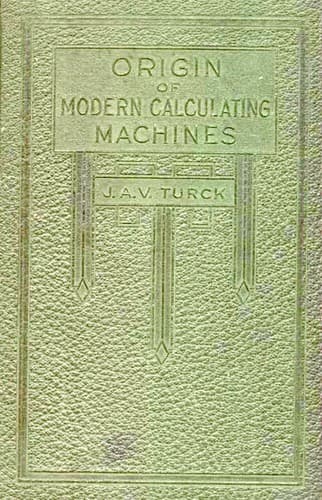
Origin of modern calculating machinesTurck, J. A. V.
History
Origin of modern calculating machines
Turck, J. A. V.
Calculators
The presence of these machines in the bank also had a tendency to
influence business-men to install recorders where the key-driven
calculator would have given far greater results in quantity of work and
expense of operating. In these days, however, the average businessman
is alive to his requirements, and selects what is best suited to his
needs instead of being influenced by seeing a machine used by others
for an entirely different purpose. The theory of using the printed list
of items as a means of checking back has blown into a bubble and burst,
and the non-lister has come into its own, not but what there has always
been a good sale for these machines except for the first four years.
[Sidenote: _Improvements slow for first few years_]
On account of the years it took to educate business into the use of
these two types of accounting machines, and the fact that the sales
of both were small at first, there were few improvements for several
years, as improvements depend upon prosperity.
Such changes as have been made since were largely aimed at refinements,
but there are some very noteworthy features added to the performance of
both types of machines, which are explained and described in following
chapters, where the subject will be treated under the class of machines
they affect.
[Illustration]
[Illustration: The High-Speed Calculator]
The High-Speed Calculator
As previously stated, the calculating machine was old when Felt
improved the Art by combining the key-drive with a plurality of
co-operative orders of adding mechanism. The advantage in the machine
he produced existed in the great increase in rapid manipulation which
it offered over the older Art, especially in addition. To improve
upon Felt’s contribution to the Art of calculating machines from a
commercial standpoint demanded a combination that would give still
greater possibilities in rapid manipulation.
[Sidenote: _Felt improvements on Comptometer_]
The patent records show that Felt again came to the front and gave
to the public a new machine containing many new combinations of
highly-organized mechanism that produced the above-named result. The
patents showing these features are Nos. 762,520 and 762,521, the two
patents being divisional patents of the same machine.
Although there were several patents on key-driven calculators issued to
others and a key-driven calculator placed on the market, which was sold
to some extent, none of these calculators offered anything that would
increase the possibility of more rapid manipulation than was to be had
from Felt’s old Comptometer.
[Sidenote: _Scientific distribution of functions_]
Public-domain text, read in full here on John Shaqi.
Reviews
Reviews
No reviews yet
Be the first to share your thoughts on this work.
Join the Discussion
Join the discussion
Sign in to leave a comment or review.
Sign InorCreate an account