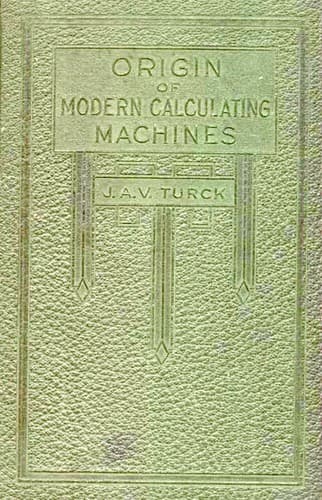
Origin of modern calculating machinesTurck, J. A. V.
History
Origin of modern calculating machines
Turck, J. A. V.
Calculators
The foregoing illustration of the idiosyncrasies of mechanical
construction offer a good example of why perpetual motion is not
possible, viz., that no mechanism was ever made that would not consume
a certain per cent of the power delivered to it, through friction
and inertia. Of course, expert knowledge of the physical laws of
mechanics allow of the application of force along the lines of least
resistance, and it is with this feature that the new improvements in
the Comptometer have to do.
[Sidenote: _Felt’s improved method of carrying_]
It would seem that the old carrying means could not be improved upon
under the circumstances, but Felt conceived a means which gave more
time for the storage of power for the carry and all kinds of time for
its delivery, which decreased the power required for carrying by a
very large per cent. The means he devised was a motor-type of carrying
mechanism that could receive and deliver power at the same time without
interference. Thus the full revolution of the lower wheel could be
utilized in storage and the same amount of time could be consumed in
delivery if necessary, but it was never required.
This tremendous reduction in power required to turn the higher wheel
in a carrying operation so decreased the resistance of turning the
numeral wheels that the former means used to control the wheels
during actuation was unsafe; that is, the old method of jabbing the
stop detent between the pins of the numeral wheel to stop it was not
dependable with the increased speed that the numeral wheels revolved,
under the reduced resistance.
Again, the feature of time was at issue. The wheels could be whirled
at tremendous speed or at a very slow speed. A sudden jab at a key
with the finger sent the numeral wheels kiting ahead of the rest of
the mechanism so that the detent could not be depended upon to enter
between the right pins, which would result in erroneous calculation.
In the new machine, we find that to overcome this unevenness of action,
Felt reversed the ratchet action of the denomination actuators, so
that no wheel action occurred on their down-stroke under the action
of the keys, but on the upstroke of the actuators the numeral wheels
were turned by the power of the actuator springs stored by the key
depression, thus giving an even set rotating action that could not be
forced and that could be controlled by a stop detent.
As the timing of this stop-action was coincident with the stopping of
the actuators on their upstroke, the actuator was used to perform this
function in combination with a detent device that could be released
from the wheel independent of the actuators to allow a carry to be
delivered.
[Sidenote: _Gauging and controlling prime actuation_]
Public-domain text, read in full here on John Shaqi.
Reviews
Reviews
No reviews yet
Be the first to share your thoughts on this work.
Join the Discussion
Join the discussion
Sign in to leave a comment or review.
Sign InorCreate an account