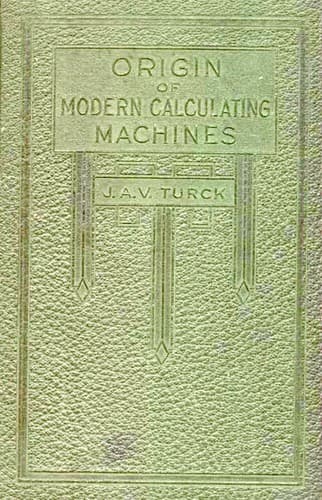
Origin of modern calculating machinesTurck, J. A. V.
History
Origin of modern calculating machines
Turck, J. A. V.
Calculators
A feature worthy of note connected with this change is displayed in
the method in which Felt overcame the timing of the stop action of the
actuators in the downward action they received from the keys, which
would have been as hard to control as it was to control the wheels
under direct key action.
[Sidenote: _Alternating stop scheme_]
The scheme he devised gave more than double the time to perform the
function of intercepting the lightning action with which the actuators
moved under a quick key-stroke. The scheme shows a dual alternating
stop-action constructed by the use of two stops acting at different
levels and co-acting alternately with five equi-spaced stop-shoulders
on the front end of the actuators, which were also arranged in
different levels.
The two stops were actuated by the keys in a similar manner to the
single stop which co-operated with the pins of the wheel in the old
“Comptometer,” except that the odd keys operated one stop while the
even keys operated the other.
Thus in the new “Comptometer” the (1) key acted to throw the higher
level stop into the path of the lowest stop-shoulder on the actuator,
and the (2) key acted to throw the lower level stop into the path of
the same stop-shoulder on the actuator. In the same manner the (3)
and (4) keys caused the odd and even stops to engage the next higher
stop-shoulder on the actuator and so on with the rest of the keys.
As the spacing was doubled by the use of but five stop-shoulders, the
stops were allowed double the time for entry between the stop-shoulders
plus the space that the pin occupied as compared with former method,
which was considerably more than double the time allowed for the same
function in the old machine.
Besides the redistribution of mechanical functions, another very
noteworthy feature is found in these patents which, in the specific
means disclosed, constituted another distribution of time for
mechanical action. This in the capacity of the machine was what has
become commercially known as the “Duplex” feature.
In the old “Comptometer” it was necessary to operate the keys
alternately, as a carry from one order to a higher order might be
taking place and thus be lost in the action of the higher order wheel
while rotating under key-action.
[Sidenote: _Multiplex key action_]
In the machine of the later patents the carry was delayed while the
higher-order wheel was under key-action. The construction shown
consisted of a latch operated by the actuators, which, when the
actuator was depressed, latched up the delivery end of the motor
carrying-device so that a carry due to take place at that time would
be intercepted until the actuator returned to normal again, at which
time the carrying motor device was again free to deliver the carry.
This feature allowed the striking of keys in several or all the orders
simultaneously, alternately, or any way the operator pleased, which was
a great improvement in speedy operativeness.
Public-domain text, read in full here on John Shaqi.
Reviews
Reviews
No reviews yet
Be the first to share your thoughts on this work.
Join the Discussion
Join the discussion
Sign in to leave a comment or review.
Sign InorCreate an account