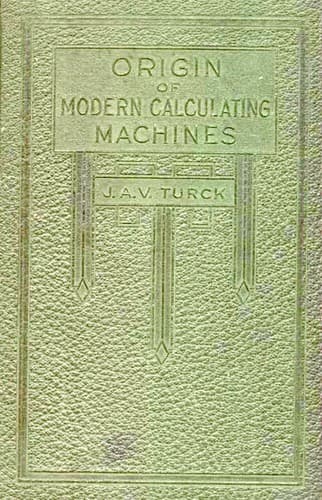
Origin of modern calculating machinesTurck, J. A. V.
History
Origin of modern calculating machines
Turck, J. A. V.
Calculators
Now it may be said that the locking of other orders was old in the
cash register; but let us analyze the scheme and action of both. The
depression of a key of the key-driven cash register immediately locked
all other keys not depressed, and retained such locking-action during
depression and until the complete return of such key-depression; thus
the keyboard was locked, error or no error.
[Sidenote: _Inactive keys not locked during proper key-action in
“Comptometer”_]
A correct depression of a key in Felt’s new invention, as applied to
key-driven calculators, does not lock the rest of the keys. In fact, no
key of Felt’s invention is locked until an error occurs.
The lock of the key-driven cash register is a lock that takes effect
without an error having occurred--one that is always present with
respect to the keys not depressed simultaneously, and a feature
designed to force simultaneity of group key-action to prevent, as
before explained, dishonesty.
The lock of the key-driven calculator inventions referred to are
in no way connected with simultaneous key-action--as in the cash
register--and never act to lock the other orders except when there is
an error in a key-stroke. As the writer has explained respecting the
simultaneous feature of the cash register, the locking of the other
orders in the cash register interfered with the flexibility of the
key-action and for that reason would be impossible in a key-driven
calculator, where rapid manipulation is dependent on flexibility.
The scheme of the new key-driven calculator inventions referred to,
were designed to allow perfect freedom of individual key-action and
to block such action only when an error in any individual key-stroke
should be made. There is nothing in common in the two schemes. The
time, purpose and mechanical means employed differ entirely.
[Sidenote: “_Controlled-key Comptometer_”]
This new idea of Felt’s is embodied in what is commercially known as
the “Controlled-key Duplex Comptometer.” The term “Controlled-key” was
coined to fit this broadly new combination, but a word coined to fit
the functions of a new mechanism is seldom enough to convey a complete
understanding of its true qualities.
Aside from the broad newness of the Felt “Controlled-key” feature
referred to, even the mechanical means for safeguarding the individual
key-action was new in its application as a full-stroke device. The
means employed operated directly on the accumulator mechanism, locking
it against registration until the error was corrected, which differed
greatly from the devices applied to the keys or actuators designed by
others to bring about a similar result. But the locking of all the
other orders of mechanism, through any key-action short of a full
stroke, as a signal or error, has no mechanical equivalent or simile in
the Art.
The Improved Recorder
[Sidenote: _The mass of recorder inventions patented_]
Public-domain text, read in full here on John Shaqi.
Reviews
Reviews
No reviews yet
Be the first to share your thoughts on this work.
Join the Discussion
Join the discussion
Sign in to leave a comment or review.
Sign InorCreate an account