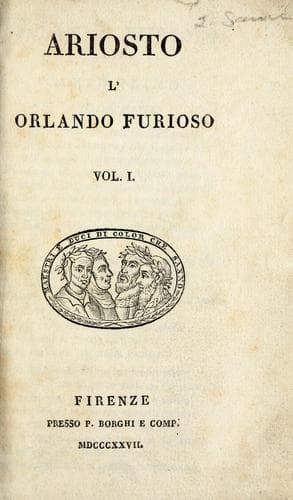
Epic poetry, Italian -- Translations into English; Knights and knighthood -- Poetry; Roland (Legendary character) -- Romances
LXIII
The captain of this crew, which blocked the road,
Appeared, with monstrous paunch and bloated face;
Who a slow tortoise for a horse bestrode,
That passing sluggishly with him did pace:
Down looked, some here, some there, sustained the load,
For he was drunk, and kept him in his place.
Some wipe his brows and chin from sweat which ran,
And others with their vests his visage fan.
LXIV
One, with a human shape and feet, his crest,
Fashioned like hound, in neck and ears and head,
Bayed at the gallant Child with angry quest,
To turn him to the city whence he fled.
"That will I never, while of strength possessed
To brandish this," the good Rogero said:
With that his trenchant faulchion he displayed,
And pointed at him full the naked blade.
LXV
That monster would have smote him with a spear,
But swiftly at his foe Rogero sprung,
Thrust at his paunch, and drove his faulchion sheer
Through his pierced back a palm; his buckler flung
Before him, and next sallied there and here:
But all too numerous was the wicked throng.
Now grappled from behind, now punched before,
He stands, and plies the crowd with warfare sore.
LXVI
One to the teeth, another to the breast,
Of that foul race he cleft; since no one steeled
In mail, his brows with covering helmet dressed,
Or fought, secured by corslet or by shield;
Yet is he so upon all quarters pressed,
That it would need the Child, to clear the field,
And to keep off the wicked crew which swarms,
More than Briareus' hundred hands and arms.
LXVII
If he had thought the magic shield to show,
(I speak of that the necromancer bore,
Which dazed the sight of the astonished foe,
Left at his saddle by the wizard Moor)
That hideous band, in sudden overthrow,
Blinded by this, had sunk the knight before.
But haply he despised such mean as vile,
And would prevail by valour, not by guile.
LXVIII
This as it may: the Child would meet his fate,
Ere by so vile a band be prisoner led;
When, lo! forth issuing from the city's gate,
Whose wall appeared like shining gold I said,
Two youthful dames, not born in low estate,
If measured by their mien and garb, nor bred
By swain, in early wants and troubles versed;
But amid princely joys in palace nursed!
LXIX
On unicorn was seated either fair,
A beast than spotless ermine yet more white;
So lovely were the damsels, and so rare
Their garb, and with such graceful fashion dight,
That he who closely viewed the youthful pair,
Would need a surer sense than mortal sight,
To judge between the two. With such a mien
Embodied Grace and Beauty would be seen.
Public-domain text, read in full here on John Shaqi.
Reviews
Reviews
No reviews yet
Be the first to share your thoughts on this work.
Elsewhere in the archive
Join the Discussion
Join the discussion
Sign in to leave a comment or review.
Sign InorCreate an account