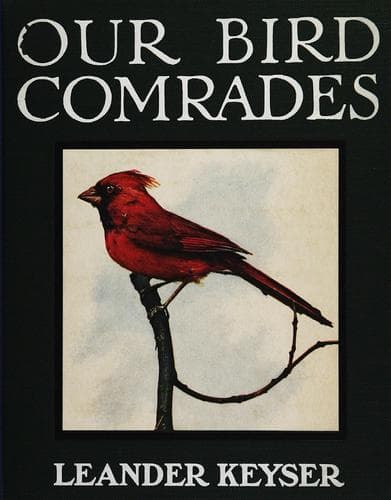
Our Bird ComradesKeyser, Leander S. (Leander Sylvester)
History
Our Bird Comrades
Keyser, Leander S. (Leander Sylvester)
Birds
Their nests are set amid the rocks, and are quite bulky, the walls
composed of grasses and the lining consisting of soft feathers. In
order to procure the grasses required, they must descend at least to
the belt of scant vegetation just below the region of bare rocks and
boulders. Where they get the downy feathers for the carpet of their
nurseries I have not been able to ascertain. No nest has yet been
discovered below an elevation of 12,000 feet. Our little bird may,
indeed, be called a "haunter of the sky." The height of the breeding
season is in the latter part of July. The broods having left the
nests, old and young gather in small flocks and range over the peaks
and ridges, feeding on the insects to be found on the fields of snow.
No less interesting are the habits of these birds in winter. In
October and November most of them descend only to the timber line,
where they remain throughout the winter, save as they are driven down
into the denser forests by the fierce tempests of this arctic region.
What feathered Vikings they are! They do not even make for themselves
snow huts for protection from the winter storms. However, a few
descend almost to the base of the foothills, while others--perhaps the
less hardy--seek a blander climate in the northern part of Mexico.
There are in North America four other species of the genus Leucosticte;
the Aleutian, whose habitat is the Aleutian and Prybilof islands and
east as far as the island of Kadiak; the gray-crowned, which breeds in
British America near the Rocky Mountains, comes to Colorado in winter,
and has been taken as far east as western Iowa; the Hepburn, dwelling
chiefly in the mountain ranges of the Pacific coast, breeding mostly in
the far North, and in winter coming as far south and east as Nevada and
Colorado; and, lastly, the black leucosticte, which winters in the
central latitudes in the Rocky Mountains and whose summer range and
breeding home is unknown to men of science.
HAPPENINGS BY THE WAY
If one were to keep on writing monographs of all our interesting avian
species, the books that would result would make a good-sized library.
The few examples that have been given will illustrate what can be done
in this direction with the help of the field glass and the handbook. A
few chapters will now be given on what might be called "odds and ends
of bird life," and these are written not only for the information they
may impart, but also for the purpose of showing how many interesting
facts can be gathered along the way by the method of bird study
commended in our opening chapter.
Public-domain text, read in full here on John Shaqi.
Reviews
Reviews
No reviews yet
Be the first to share your thoughts on this work.
Join the Discussion
Join the discussion
Sign in to leave a comment or review.
Sign InorCreate an account