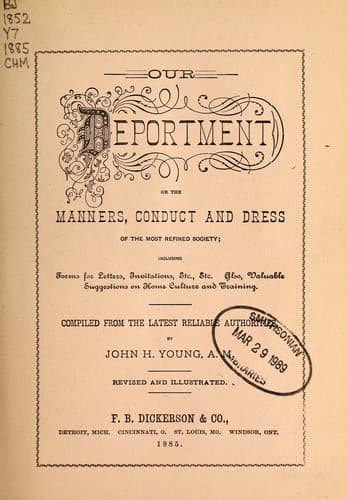
Our Deportment: Or the Manners, Conduct and Dress of the Most Refined SocietyYoung, John H.
General
Our Deportment: Or the Manners, Conduct and Dress of the Most Refined Society
Young, John H.
Etiquette
To return a call made in person with a card inclosed in an envelope, is
an intimation that visiting between the parties is ended. Those who
leave or send their cards with no such intention, should not inclose
them in an envelope. An exception to this rule is where they are sent in
return to the newly married living in other cities, or in answering
wedding cards forwarded when absent from home. P.P.C. cards are also
sent in this way, and are the only cards that it is as yet universally
considered admissible to send by post.
SIZE AND STYLE OF VISITING OR CALLING CARDS.
A medium sized is in better taste than a very large card for married
persons. Cards bearing the name of the husband alone are smaller. The
cards of unmarried men should also be small. The engraving in simple
writing is preferred, and without flourishes. Nothing in cards can be
more commonplace than large printed letters, be the type what it may.
Young men should dispense with the "Mr." before their names.
[Illustration: CALLING CARDS.]
CORNERS OF CARDS TURNED DOWN.
The signification of turning down the corners of cards are:
_Visite_--The right hand upper corner.
_Felicitation_--The left hand upper corner.
_Condolence_--The left hand lower corner.
_P.P.C._ }
_To Take Leave_ } The right hand lower corner.
Card, right hand end turned down--_Delivered in Person._
CARD FOR MOTHER AND DAUGHTER.
The name of young ladies are sometimes printed or engraved on their
mother's cards; both in script. It is, of course, allowable, for the
daughter to have cards of her own.
Some ladies have adopted the fashion of having the daughter's name on
the same card with their own and their husband's names.
GLAZED CARDS.
Glazed cards are quite out of fashion, as are cards and note paper with
gilt edges. The fashion in cards, however, change so often, that what is
in style one year, may not be the next.
P.P.C. CARDS.
A card left at a farewell visit, before a long protracted absence, has
"P.P.C." (Pour Prendre Conge) written in one corner. It is not necessary
to deliver such cards in person, for they may be sent by a messenger, or
by post if necessary. P.P.C. cards are not left when the absence from
home is only for a few months, nor by persons starting in mid-summer for
a foreign country, as residents are then supposed to be out of town.
They are sent to or left with friends by ladies just previous to their
contemplated marriage to serve the purpose of a call.
CARDS OF CONGRATULATION.
Public-domain text, read in full here on John Shaqi.
Reviews
Reviews
No reviews yet
Be the first to share your thoughts on this work.
Join the Discussion
Join the discussion
Sign in to leave a comment or review.
Sign InorCreate an account