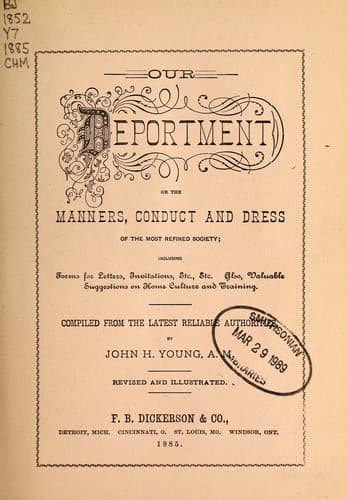
Our Deportment: Or the Manners, Conduct and Dress of the Most Refined SocietyYoung, John H.
General
Our Deportment: Or the Manners, Conduct and Dress of the Most Refined Society
Young, John H.
Etiquette
An authentic writer upon visiting cards says: "To the unrefined or
underbred, the visiting card is but a trifling and insignificant bit of
paper; but to the cultured disciple of social law, it conveys a subtle
and unmistakable intelligence. Its texture, style of engraving, and even
the hour of leaving it combine to place the stranger, whose name it
bears, in a pleasant or a disagreeable attitude, even before his
manners, conversation and face have been able to explain his social
position. The higher the civilization of a community, the more careful
it is to preserve the elegance of its social forms. It is quite as easy
to express a perfect breeding in the fashionable formalities of cards,
as by any other method, and perhaps, indeed, it is the safest herald of
an introduction for a stranger. Its texture should be fine, its
engraving a plain script, its size neither too small, so that its
recipients shall say to themselves, 'A whimsical person,' nor too large
to suggest ostentation. Refinement seldom touches extremes in
anything."
CALLING CARDS.
A card used in calling should have nothing upon it but the name of the
caller. A lady's card should not bear her place of residence; such cards
having, of late, been appropriated by the members of the demi-monde. The
street and number always look better upon the card of the husband than
upon that of the wife. When necessary, they can be added in pencil on
the cards of the wife and daughter. A business card should never be used
for a friendly call. A physician may put the prefix "Dr.," or the affix
"M.D.," upon his card, and an army or navy officer his rank and branch
of service.
WEDDING CARDS.
Wedding cards are only sent to those people whom the newly married
couple desire to keep among their acquaintances, and it is then the duty
of those receiving the cards to call first on the young couple.
An ancient custom, but one which has been recently revived, is for the
friends of the bride and groom to send cards; these are of great variety
in size and design, and resemble Christmas or Easter cards but are
usually more artistic.
CHRISTMAS AND EASTER CARDS.
A very charming custom that is coming into vogue is the giving or
sending of Easter and Christmas cards. These are of such elegant designs
and variety of colors that the stationer takes great pride in
decorating his shop windows with them; indeed some of them are so
elegant as to resemble oil paintings. Books and other small offerings
may accompany cards as a token of remembrance.
CARDS TO SERVE FOR CALLS.
A person may make a card serve the purpose of a call, and it may either
be sent in an envelope, by messenger or left in person. If left in
person, one corner should be turned down. To indicate that a call is
made on all or several members of the family; the card for the lady of
the house is folded in the middle. If guests are visiting at the house,
a card is left for each guest.
ENCLOSING A CARD IN AN ENVELOPE.
Public-domain text, read in full here on John Shaqi.
Reviews
Reviews
No reviews yet
Be the first to share your thoughts on this work.
Join the Discussion
Join the discussion
Sign in to leave a comment or review.
Sign InorCreate an account