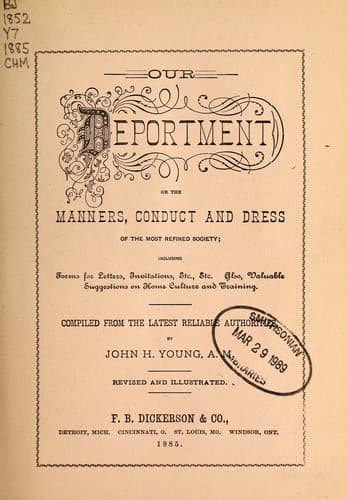
Our Deportment: Or the Manners, Conduct and Dress of the Most Refined SocietyYoung, John H.
General
Our Deportment: Or the Manners, Conduct and Dress of the Most Refined Society
Young, John H.
Etiquette
The correct use of words is indispensable to a good talker who would
escape the unfavorable criticism of an educated listener. There are many
words and phrases, used in some cases by persons who have known better,
but who have become careless from association with others who make
constant use of them. "Because that" and "but that" should never be used
in connection, the word "that" being entirely superfluous. The word
"vocation" is often used for "avocation." "Unhealthy" food is spoken of
when it should be "unwholesome." "Had not ought to" is sometimes heard
for "ought not to;" "banister" for "baluster;" "handsful" and
"spoonsful" for "handfuls" and "spoonfuls;" "it was him" for "it was
he;" "it was me" for "it was I;" "whom do you think was there?" for "who
do you think was there?"; "a mutual friend" for "a common friend;" "like
I did" instead of "as I did;" "those sort of things" instead of "this
sort of things;" "laying down" for "lying down;" "setting on a chair"
for "sitting on a chair;" "try and make him" instead of "try to make
him;" "she looked charmingly" for "she looked charming;" "loan" for
"lend;" "to get along" instead of "to get on;" "cupalo" instead of
"cupola;" "who" for "whom"--as, "who did you see" for "whom did you
see;" double negatives, as, "he did not do neither of those things;"
"lesser" for "least;" "move" instead of "remove;" "off-set" instead of
"set-off," and many other words which are often carelessly used by those
who have been better taught, as well as by those who are ignorant of
their proper use.
SPEAKING ONE'S MIND.
Certain honest but unthinking people often commit the grievous mistake
of "speaking their mind" on all occasions and under all circumstances,
and oftentimes to the great mortification of their hearers. And
especially do they take credit to themselves for their courage, if their
freedom of speech happens to give offense to any of them. A little
reflection ought to show how cruel and unjust this is. The law restrains
us from inflicting bodily injury upon those with whom we disagree, yet
there is no legal preventive against this wounding of the feeling of
others.
UNWISE EXPRESSION OF OPINION.
Another class of people, actuated by the best of intentions, seem to
consider it a duty to parade their opinions upon all occasions, and in
all places without reflecting that the highest truth will suffer from an
unwise and over-zealous advocacy. Civility requires that we give to the
opinions of others the same toleration that we exact for our own, and
good sense should cause us to remember that we are never likely to
convert a person to our views when we begin by violating his notions of
propriety and exciting his prejudices. A silent advocate of a cause is
always better than an indiscreet one.
PROFANITY.
Public-domain text, read in full here on John Shaqi.
Reviews
Reviews
No reviews yet
Be the first to share your thoughts on this work.
Elsewhere in the archive
Join the Discussion
Join the discussion
Sign in to leave a comment or review.
Sign InorCreate an account