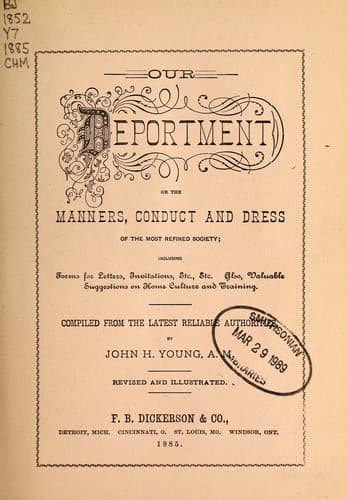
Our Deportment: Or the Manners, Conduct and Dress of the Most Refined SocietyYoung, John H.
General
Our Deportment: Or the Manners, Conduct and Dress of the Most Refined Society
Young, John H.
Etiquette
No lady should make use of any feminine substitute for profanity. The
woman who exclaims "The Dickens!" or "Mercy!" or "Goodness!" when she is
annoyed or astonished, is as vulgar in spirit, though perhaps not quite
so regarded by society, as though she had used expressions which it
would require but little stretch of the imagination to be regarded as
profane.
WIT.
You may be witty and amusing if you like, or rather if you can; but
never use your wit at the expense of others.
"Wit's an unruly engine, wildly striking
Sometimes a friend, sometimes the engineer;
Hast thou the knack? pamper it not with liking;
But if thou want it, buy it not too dear.
Many affecting wit beyond their power
Have got to be a dear fool for an hour."--HERBERT.
DISPLAY OF EMOTIONS.
Avoid all exhibitions of temper before others, if you find it impossible
to suppress them entirely. All emotions, whether of grief or joy, should
be subdued in public, and only allowed full play in the privacy of your
own apartments.
IMPERTINENT QUESTIONS.
Never ask impertinent questions. Some authorities in etiquette even go
so far as to say that _all_ questions are strictly tabooed. Thus, if you
wished to inquire after the health of the brother of your friend, you
would say, "I hope your brother is well," not, "How is your brother's
health?"
THE CONFIDENCE OF OTHERS.
Never try to force yourself into the confidence of others; but if they
give you their confidence of their own free will, let nothing whatever
induce you to betray it. Never seek to pry into a secret, and never
divulge one.
USE OF FOREIGN LANGUAGE.
Do not form the habit of introducing words and phrases of French or
other foreign languages into common conversation. This is only allowable
in writing, and not then except when the foreign word or phrase
expresses more clearly and directly than English can do the desired
meaning. In familiar conversation this is an affectation, only
pardonable when all persons present are particularly familiar with the
language.
PRETENSES.
Avoid all pretense at gentility. Pass for what you are, and nothing
more. If you are obliged to make any little economies, do not be ashamed
to acknowledge them as economies, if it becomes necessary to speak of
them at all. If you keep no carriage, do not be over-solicitous to
impress upon your friends that the sole reason for this deficiency is
because you prefer to walk. Do not be ashamed of poverty; but, on the
other hand, do not flaunt its rags unmercifully in the faces of others.
It is better to say nothing about it, either in excuse or defense.
DOGMATIC STYLE OF SPEAKING.
Public-domain text, read in full here on John Shaqi.
Reviews
Reviews
No reviews yet
Be the first to share your thoughts on this work.
Elsewhere in the archive
Join the Discussion
Join the discussion
Sign in to leave a comment or review.
Sign InorCreate an account