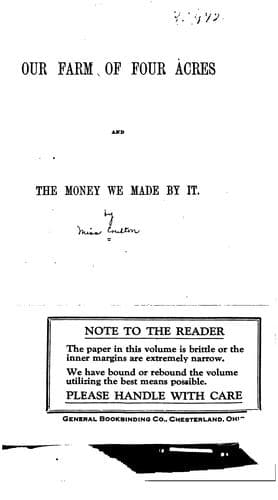
Our Farm of Four Acres and the Money We Made by It — John Shaqi
Our Farm of Four Acres and the Money We Made by ItCoulton, Miss
History
Our Farm of Four Acres and the Money We Made by It
Coulton, Miss
Agriculture; Farm life
It is one of the great advantages of the country that nothing is lost,
and thus the straw which figures so largely in the bill of a London
corn-chandler, and which, when converted into manure, is the
perquisite of your groom, becomes in the country the means of
rendering your garden productive.
Before I resided in the country the pony cost me more than four times
the sum I have mentioned; the stable was apart from the house, and I
knew nothing for months of the bills run up on his account. I had once
a bill sent in for sugar! "Why, George, what can the pony want with
sugar?"
"Why, ma'am, you said some time ago that the pony looked thin, so
lately I have always mixed sugar with his corn; nothing fattens a
horse like sugar."
Now what could I complain of? This man had been recommended to me as
a "treasure," and one who would do his duty by the pony, which, I may
mention, was a very beautiful one, and a great pet; so if George
considered sugar good for him, what could I do but pay the bill, and
say, "Let him have sugar, by all means?" Not that "Bobby" was a bit the
fatter or better for having his corn sweetened. An intimate friend of
mine, who always kept three or four horses, laughed outright when I
told him that the pony had consumed such a quantity of sugar, and
expressed his opinion that very little of that article had ever been
in his manger. Under the same superintendence "Bobby" wore out four
times the number of shoes; and as at that time I had to purchase hay
and straw as well as corn, all on the same scale of magnitude, the
expense of keeping the little carriage really did cost more than the
convenience attending it was worth; and had not the pony been the gift
of a beloved friend, we should have parted with it when we quitted
London, as at that time we were ignorant how cheaply it could be
maintained in the country. There we had a servant who was content with
his wages, and did not seek to make them greater by combining with
tradesmen to defraud his employers. If any of my readers commence
keeping a pony in the country, they may rely that it need not cost
them a penny more than I have put down. Of course they must have the
hay from their own grounds, and neither reckon the cost of the straw
nor the labor of the man who attends to the pony. Ours did all the
"jobs" about the place--cleaned the knives and shoes, milked the cows,
fed the pigs and poultry, helped in the gardens, and, in short, made
himself "generally useful." Now, a servant who is able and willing to
do all this, besides properly attending to a pony and carriage, is
very difficult to be met with, but he is absolutely necessary for a
place in the country where economy has to be studied.
Public-domain text, read in full here on John Shaqi.
Reviews
Reviews
No reviews yet
Be the first to share your thoughts on this work.
Join the Discussion
Join the discussion
Sign in to leave a comment or review.
Sign InorCreate an account