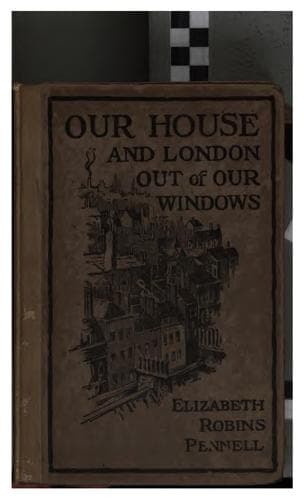
Our House and London out of Our WindowsPennell, Elizabeth Robins
General
Our House and London out of Our Windows
Pennell, Elizabeth Robins
London (England) -- Description and travel; Pennell, Elizabeth Robins, 1855-1936 -- Homes and haunts -- England -- London
Only of one thing were we sure: however hideous or horrible the evil, M.
Auguste had worked "down there," under the hot sun of Provence, Louise
had no part in it. She knew--it was the reason of her curious
reticences, of her sacrifice of herself to him. That he loved her was
inevitable. Who could help loving her? She was so intelligent, so
graceful, so gay. But that she should love M. Auguste would have been
incomprehensible, were it not in the nature of woman to love the man who
is most selfish in his dependence upon her. She did all the work, and he
had all the pleasure of it. He was always decently dressed, there was
always money in his pocket, though she, who earned it, never had a penny
to spend on herself. No matter how busy and hurried she might be, she
had always the leisure to talk to him, to amuse him when he came in,
always the courage to laugh, like the little Fleurance in the story.
What would you? She was made like that. She had always laughed, when she
was sad as when she was gay. And while she was making life delightful
for him, she was doing for us what three Englishwomen combined could not
have done so well, and with a charm that all the Englishwomen in the
world could not have mustered among them.
She had been with us about a year when I began to notice that, at
moments, her face was clouded and her smile less ready. At first, I put
it down to her endless comedy with M. Auguste. But, after a bit, it
looked as if the trouble were more serious even than his histrionics. It
was nothing, she laughed when I spoke to her; it would pass. And she
went on amusing and providing for M. Auguste and working for us. But by
the time the dark days of November set in, we were more worried about
her than ever. The crisis came with Christmas.
On Christmas Day, friends were to dine with us, and we invited
_Mademoiselle_, the French dressmaker, to eat her Christmas dinner with
Louise and M. Auguste. We were very staid in the dining-room,--it turned
out rather a dull affair. But in the kitchen it was an uproarious feast.
Though she lived some distance away, though on Christmas night London
omnibuses are few and far between, _Mademoiselle_ could hardly be
persuaded to go home, so much was she enjoying herself. Louise was all
laughter. "You have been amused?" I asked, when _Mademoiselle_, finally
and reluctantly, had been bundled off by J. in a hansom.
"_Mais oui, mais oui_," M. Auguste cried, pleasure in his voice. "_Cette
pauvre Mademoiselle!_ Her life, it is so sad, she is so alone. It is
good for her to be amused. We have told her many stories,--_et des
histoires un tout petit peu salees, n'est-ce pas? pour egayer cette
pauvre Mademoiselle?_"
It was the day after the feast that Louise had to give in. She confessed
she had been in torture while she served our dinner and _Mademoiselle_
was there. She could hardly eat or drink. But why make it sad for all
the world because she was in pain? and she had laughed, she had laughed!
Public-domain text, read in full here on John Shaqi.
Reviews
Reviews
No reviews yet
Be the first to share your thoughts on this work.
Join the Discussion
Join the discussion
Sign in to leave a comment or review.
Sign InorCreate an account