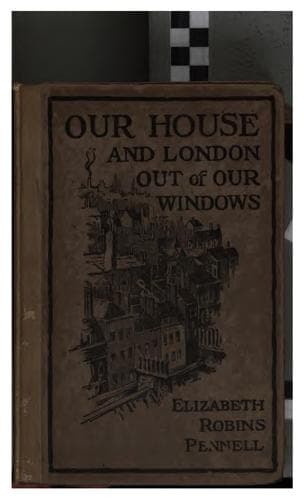
Our House and London out of Our WindowsPennell, Elizabeth Robins
General
Our House and London out of Our Windows
Pennell, Elizabeth Robins
London (England) -- Description and travel; Pennell, Elizabeth Robins, 1855-1936 -- Homes and haunts -- England -- London
dirt she had to spend the afternoon cleaning up. There were times when
they almost came to blows, for the temper of both was hot, and more than
once I heard Mrs. Burden threaten to call in the police. But the old
woman had her uses. She was honesty itself, and could be trusted with no
matter what,--from the key of our chambers, when they were left empty,
to the care of William Penn, when no other companion could be secured
for him; she could be relied upon to pay bills, post letters, fetch
parcels; and she was as punctual as Big Ben at Westminster. I do not
think she missed a day in all the years she was with me. I became
accustomed, too, to seeing her about, and there was the dread--or
conviction would be nearer the truth--that if I let her go nobody else
in their senses would take her in.
Mrs. Burden did not improve with time. She never condescended to borrow
qualities that did not belong to her. She grew more unwieldy and larger
and floppier, a misfortune she attributed to some mysterious malady
which she never named, but gloated over with the pride the poor have in
their diseases. And she grew dirtier and more disorderly, continuing to
scorn my objection to her opening the front door with the shoe she was
blacking still on her hand, or to her bringing me a letter wrapped in
an apron grimier than her grimy fingers. Nothing would induce her not to
call me "Missis," which displeased me more, if for other reasons, than
the "Master" she as invariably bestowed upon J. She bobbed no curtsies.
When, on Saturdays, coins passed from my hand to hers, she spat on them
before she put them in her pocket, to what purpose I have not to this
day divined. Her best friend could not have accused her of any charm of
manner, but, being Irish, she escaped the vulgarity bred in the London
slums. In fact, I often fancied I caught gleams of what has been called
the Celtic Temperament shining through her. She had the warmth of
devotion, the exaggeration of loyalty, the power of idealizing, peculiar
to her race. She was almost lyrical in her praise of J., who stood
highest in her esteem, and "Master good! Master good!" was her constant
refrain when she conversed with Augustine in the language fitted for
children and rich in gesture, which was her well-meant substitute for
French. She saw him glorified, as the poets of her country see their
heroes, and in her eyes he loomed a splendid Rothschild. "Master, plenty
money, plenty money!" she would assure Augustine, and, holding up her
apron by the two corners, and well out from her so as to represent a
capacious bag, add, "apron full, full, full!"
Public-domain text, read in full here on John Shaqi.
Reviews
Reviews
No reviews yet
Be the first to share your thoughts on this work.
Elsewhere in the archive
Join the Discussion
Join the discussion
Sign in to leave a comment or review.
Sign InorCreate an account