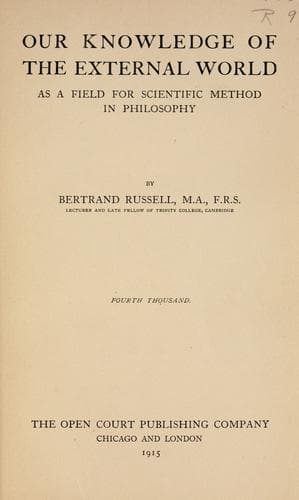
Our Knowledge of the External World as a Field for Scientific Method in PhilosophyRussell, Bertrand
Philosophy
Our Knowledge of the External World as a Field for Scientific Method in Philosophy
Russell, Bertrand
Knowledge, Theory of; Logical atomism
Before proceeding further, let us summarise the argument so far as it
has gone. The problem is: "Can the existence of anything other than our
own hard data be inferred from these data?" It is a mistake to state the
problem in the form: "Can we know of the existence of anything other
than ourselves and our states?" or: "Can we know of the existence of
anything independent of ourselves?" because of the extreme difficulty of
defining "self" and "independent" precisely. The felt passivity of
sensation is irrelevant, since, even if it proved anything, it could
only prove that sensations are caused by sensible objects. The natural
_naïve_ belief is that things seen persist, when unseen, exactly or
approximately as they appeared when seen; but this belief tends to be
dispelled by the fact that what common sense regards as the appearance
of one object changes with what common sense regards as changes in the
point of view and in the intervening medium, including in the latter our
own sense-organs and nerves and brain. This fact, as just stated,
assumes, however, the common-sense world of stable objects which it
professes to call in question; hence, before we can discover its precise
bearing on our problem, we must find a way of stating it which does not
involve any of the assumptions which it is designed to render doubtful.
What we then find, as the bare outcome of experience, is that gradual
changes in certain sense-data are correlated with gradual changes in
certain others, or (in the case of bodily motions) with the other
sense-data themselves.
The assumption that sensible objects persist after they have ceased to
be sensible--for example, that the hardness of a visible body, which has
been discovered by touch, continues when the body is no longer
touched--may be replaced by the statement that the _effects_ of sensible
objects persist, _i.e._ that what happens now can only be accounted for,
in many cases, by taking account of what happened at an earlier time.
Everything that one man, by his own personal experience, can verify in
the account of the world given by common sense and physics, will be
explicable by some such means, since verification consists merely in the
occurrence of an expected sense-datum. But what depends upon testimony,
whether heard or read, cannot be explained in this way, since testimony
depends upon the existence of minds other than our own, and thus
requires a knowledge of something not given in sense. But before
examining the question of our knowledge of other minds, let us return to
the question of the thing-in-itself, namely, to the theory that what
exists at times when we are not perceiving a given sensible object is
something quite unlike that object, something which, together with us
and our sense-organs, causes our sensations, but is never itself given
in sensation.
Public-domain text, read in full here on John Shaqi.
Reviews
Reviews
No reviews yet
Be the first to share your thoughts on this work.
Elsewhere in the archive
Join the Discussion
Join the discussion
Sign in to leave a comment or review.
Sign InorCreate an account