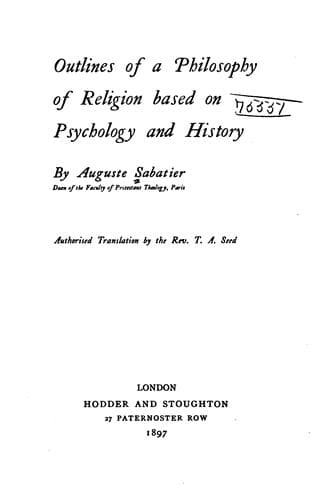
Nowhere is a universal religion the fruit of an unconscious evolution,
produced by the action of fatal and external laws. It presents itself
everywhere as an individual creation, as the free and moral work of a
few elect souls, in whom tradition by a profound crisis is purified and
enlarged. This was the role of Confucius, of Buddha, of Socrates, of
the prophets of Israel, of Mohammed in Arabia. All of them were
reformers of the religion of their ancestors.... They did not discover
the universal religion outside themselves, but in their consciousness
and personal piety. Passing through their souls as through a filter,
the traditional religion of their race was gradually clarified and
freed from foreign or material elements, and it was found that, in the
end, the new faith appeared the more human and universal as it had
become more strictly religious, more inward, and more pure.... Not
that all the ancient cults were capable of transformation or all the
prophets equally inspired. Often the revelation would appear uncertain
or incomplete. On only one point and in only one consciousness would
it be seen to end in a clear and definitive conclusion. Progress
implies selection. As we rise from one stage to another in the history
of religious evolution we see the ranks enlightened and the number
diminished of concurrent religions. At the lowest stage, the savage
cults are almost innumerable. The great national or ethnic religions
were much fewer. Only three are frankly universalist: Buddhism,
Mohammedanism, and Christianity. And these three are universalist, if
I may so say, in a very unequal degree.
Mohammedanism was far from being an original religion. The element
which gives to it a higher moral and religious value came to it from
Judaism and Christianity. Its monotheism, its horror of idolatry, the
comparative purity of its ethics, have no other source, and, without
paradox, it has been possible to represent it as an inferior form of
Christianity accommodated to the needs and to the stature of
semi-civilised Semitic peoples. But, alongside this Christian
spiritualism it has conserved naturalistic elements, gross remnants of
old Arab cults which, having made its fortune, perhaps, in its early
days, now embarrass it and paralyse it. Moreover, in spite of its
conquests, it has always remained an Oriental religion with Mecca as
its centre and its head. If it would survive, it must reform itself;
it must enter into the path of moral and intellectual progress, free
itself from local superstitions, from its gross hopes, its hatred of
the infidel, its doctrine of good works; in other words, it will have
to cast off its old nature, and receive a new effusion of the Christian
spirit. It can only become universal in so far as it approaches the
moral principle of Christianity, in order, in the end, to become one
with it.
Public-domain text, read in full here on John Shaqi.
Reviews
Reviews
No reviews yet
Be the first to share your thoughts on this work.
Elsewhere in the archive
Join the Discussion
Join the discussion
Sign in to leave a comment or review.
Sign InorCreate an account