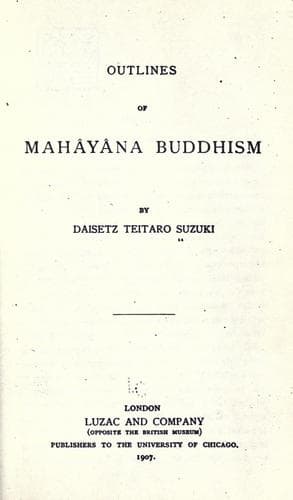
Outlines of Mahayana BuddhismSuzuki, Daisetz Teitaro
Religion
Outlines of Mahayana Buddhism
Suzuki, Daisetz Teitaro
Mahayana Buddhism -- Doctrines
Reasoning in this wise, the Mahâyânists declare that the egoism
fostered by vulgar minds belongs to this class of knowledge, though of
a different order, and that those who tenaciously cling to egoism as
their final stronghold are believers in an intellectual fata morgana,
and are like the thirsty deer that madly after the visionary water in
the desert, or like the crafty monkey that tries to catch the lunar
reflection in the water. Because the belief in the existence of a
metaphysical agent behind our mental phenomena is not confirmed by
experience and sound judgment, it being merely a product of
unenlightened subjectivity.
Besides this ethical and philosophical egoism, all forms of
world-conception which is founded on the sandy basis of subjective
illusion, such as fetichism, idolatry, anthropomorphism,
anthropopsychism, and the like, must be classed under the
_parikalpita-lakṣana_ as doctrines having illusionary premises.
_Relative Knowledge._
Next comes the _paratantra-lakṣana_, a _welt-anschauung_ based upon
relative knowledge, or better, upon the knowledge of the law of
relativity. According to this view, everything in the world has a
relative and conditional existence, and nothing can claim an absolute
reality free from all limitations. This closely corresponds to the
theory advanced by most of modern scientists, whose agnosticism denies
our intellectual capability of transcending the law of relativity.
{90}
The _paratantra-lakṣana_, therefore, consists in the knowledge
derived from our daily intercourse with the outward world. It deals
with the highest abstractions we can make out of our sensuous
experiences. It is positivistic in its strictest sense. It says: The
universe has only a relative existence, and our knowledge is
necessarily limited. Even the highest generalisation cannot go beyond
the law of relativity. It is impossible for us to know the first cause
and the ultimate end of existence; nor have we any need to go thus
beyond the sphere of existence, which would inevitably involve us in
the maze of mystic imagination.
Public-domain text, read in full here on John Shaqi.
Reviews
Reviews
No reviews yet
Be the first to share your thoughts on this work.
Join the Discussion
Join the discussion
Sign in to leave a comment or review.
Sign InorCreate an account