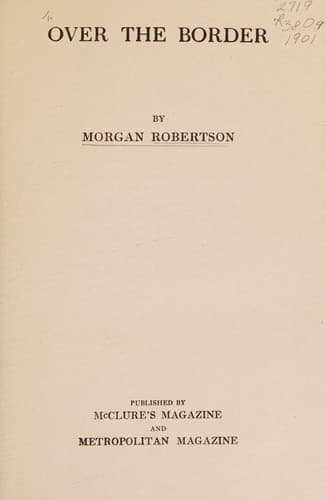
American fiction -- 20th century; Short stories, American
This continued through the years, while her hair became whiter and
her voice nearly silent, while Jack finished his course and sea term,
to be then retired against his will because of the preponderance of
officers in a wooden navy too small for them, and while my practice
and my health left me under the strain of caring for the queenly woman
I loved. Then Jack, a born free-lance who would have entered any navy
in the world had a war been on, did the next best thing for him; he
secured command of a large, new merchant ship, and made a successful
voyage, perhaps the youngest and probably the best educated master in
the merchant marine. When he returned my nerves were as bad as his
mother's, my practice was gone, my future uncertain; and so we accepted
his invitation to make a voyage with him, I with the listlessness of
all neurasthenics, my wife with an avidity which surprised us. She
brightened at once.
And now this story really begins.
II
She was a two-thousand-ton, double topgallant and skysail yard
ship--one of the larger, slower type that succeeded the old Cape Horn
clippers, but a ship that even a naval officer might feel proud to
command; and Jack was certainly proud of her. And as we--his mother
and myself--watched him pacing the poop-deck as sail was being made,
giving an occasional quiet order to the helmsman or sending a brazen
roar forward to the mate on the forecastle, we were frankly proud of
him. Six feet tall to an inch, straight as a man may be, with a chest
almost as deep as his shoulders were broad, sunburned and brown-eyed,
with only a well-kept mustache to relieve the boyishness of his face,
he presented a picture that brought light into the eyes and a smile to
the face of that mother as she stood beside me. But a contrasting look
of pain followed, and I knew the thought behind was of the other boy,
of whom we never spoke.
The first mate was a huge, hairy, brutal sort of man, uneducated beyond
the mechanical formulas of navigation, but with a large and healthy
conception of his own value to the ship and her people. The second mate
was like him to a lesser extent--not quite so big, nor brutal, nor
profane, and with less of the art of navigation.
At eight bells of that first evening out the men were chosen into
watches by the two mates much as boys choose sides in a ball game, and
my wife and I drew amidships to witness the scene. They were an unkempt
lot in the moonlight, mostly foreigners, and clad in greasy and tarry
garments of nondescript pattern and shape. Each called out his name as
he was chosen, moving to starboard or port, according to the watch he
now belonged to, and when the job was half done Jack, smoking a cigar,
joined us and critically scanned his crew.
"Relieve the wheel and lookout," said the mate, when the last man was
chosen. "That'll do the watch."
Public-domain text, read in full here on John Shaqi.
Reviews
Reviews
No reviews yet
Be the first to share your thoughts on this work.
Elsewhere in the archive
Join the Discussion
Join the discussion
Sign in to leave a comment or review.
Sign InorCreate an account