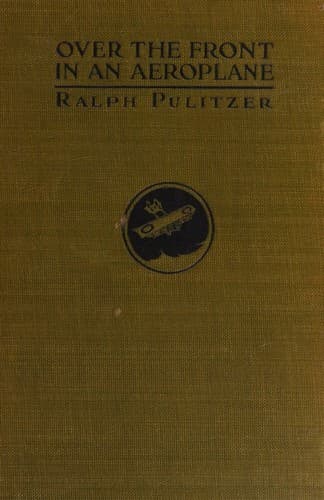
Over the Front in an Aeroplane, and Scenes Inside the French and Flemish TrenchesPulitzer, Ralph
History
Over the Front in an Aeroplane, and Scenes Inside the French and Flemish Trenches
Pulitzer, Ralph
World War, 1914-1918 -- Personal narratives
One must realize the shattered condition in which they were swept from
Antwerp back to the very fringe of their country behind the Yser. One
must realize that they are practically an army without a country. One
must understand that when they get furloughs they cannot spend them
with their families in their homes, getting comfort and encouragement.
They either stay within sound of the firing or spend a bleak six days
among the strangers of England or of Northern France. When all this is
considered their material reorganization and the preservation of their
_morale_ in its present splendid shape is a remarkable achievement.
And let no one forget that if the British proudly saved the French by
their retreat from Mons (which no one seems likely to be allowed to
forget) it is equally certain that the shattered Belgian army humbly
saved the British on the Yser.
Rolling along the straight highroad to Y---- we passed the usual
congestion of troop-filled trolley-cars, lorries, ambulances,
farm-wagons, officers' autos and motor-cyclists. Our military motor was
an excellent one, with the one fault that it seemed extremely difficult
for the chauffeur to shift his gear from neutral into low speed, and
he would frequently get hung up for several seconds with the car at a
standstill till finally he got his gears in mesh.
At one point we stopped to see an interesting manifestation of the
newly developing art of war. A giant 12-inch British naval gun was
mounted on a specially designed railroad truck. It stood on a railway
siding, with its ammunition-car coupled on behind. A kind of crane
stood ready to swing the huge shells from the ammunition-car to the
breech of the gun. When some object was found worth firing 12-inch
shells at, the engine backed up to the gun-truck with steam up. The
track was cleared.
Then the great gun did its firing at the object, and forthwith was
whisked away one, five or ten miles down the track out of danger of
the German replies. This is what, officers seem agreed, will take the
place of the antiquated fixed fortresses--miles of railway loops and
sidings running behind artificial concealments or in semi-open cuts,
with batteries of heavy fortress guns shuttling to and fro, firing and
changing position constantly.
We motored on till we neared the point where the Belgian army ends and
the French begins. Here we paid our respects to the General in command
of the division we were visiting. He promptly asked us to lunch, and
a very good lunch it was: Vegetable soup, some entrée which I could
not identify, shoulder of mutton with potatoes and beans, cantaloupe,
cheese and black coffee, with a choice between beer, claret and white
wine to drink at lunch, a glass of champagne at dessert, and liqueurs
with the coffee.
Public-domain text, read in full here on John Shaqi.
Reviews
Reviews
No reviews yet
Be the first to share your thoughts on this work.
Elsewhere in the archive
Join the Discussion
Join the discussion
Sign in to leave a comment or review.
Sign InorCreate an account