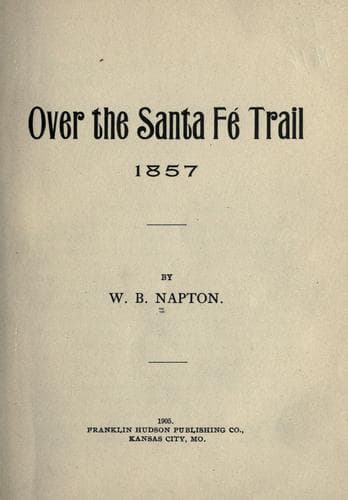
Over the Santa Fé Trail, 1857Napton, William Barclay
History
Over the Santa Fé Trail, 1857
Napton, William Barclay
Santa Fe National Historic Trail
After we passed above that part of the river with which the pilots
were thoroughly acquainted, it was necessary to tie up at night, and
much time was consumed in cutting wood. The boat was also delayed some
time at Cedar Island, an island covered with a dense grove of cedar,
growing so thick that the trees were void of branches or knots, forming
excellent smooth poles that were used for various purposes at the
trading posts, and a great quantity of these poles were cut and brought
on board. This was the only island in the river on which the growth
was entirely cedar, and on this island the Indians procured their
lodge-poles.
On this part of the river one could sit on the deck of the boat and
enjoy the vast expanse of country, gradually sloping from the river
to the hills, miles in extent, generally monotonous to be sure, but
sublime in its vastness and simplicity. Here and there herds of deer
and antelopes and packs of wolves went scampering off, alarmed by the
noise of the boat. There were two large wolf hounds on board, partly
greyhounds, being sent up to one of the trading posts.
On one occasion while the boat was landed to cut wood they were taken
on shore and turned loose to chase a large wolf, seen not far off. The
dogs put after him, soon running at full speed, in our view for a mile
or more, overtaking the wolf, but declining to seize him, not having
been yet trained for coursing wolves.
At the Mandan village, on the right bank, just above the present site
of Bismarck, we found the first abode of Indians having the resemblance
of permanency, their houses being of earth, supported by timbers on
the inside, rounded up like a big potato hill, so as turn the rain. At
this point Lewis and Clark spent the winter of 1804–5, on their famous
journey across the mountains to the Pacific Ocean. The Rees, some
distance above on the left bank of the river, had houses of similar
construction, all the other tribes having portable lodges of poles and
rawhides.
Forts Berthold, Clark and Union were the main trading posts above, and
at each of these we found numbers of Indians collected to meet the
agents, and at which we landed of course to hold the usual council
and talk followed by the delivery of their proper share of the goods
provided for them. As we approached nearer the British possessions the
Indians were pretty well supplied with guns, obtained from the British
traders, a short, smooth bore, cheap-looking affair, but handy enough
for killing buffalo on horseback, while running.
Some of our passengers busied themselves during our stay at these
places in purchasing bows and arrows, pipes, shields, moccasins, etc.,
to be preserved as mementoes of the Indians. The young Englishman, Mr.
Lace, was particularly active in the acquisition of these articles
of Indian make, and so was the barkeeper of the boat, who acquired a
general assortment to take back with him to St. Louis.
Public-domain text, read in full here on John Shaqi.
Reviews
Reviews
No reviews yet
Be the first to share your thoughts on this work.
Join the Discussion
Join the discussion
Sign in to leave a comment or review.
Sign InorCreate an account