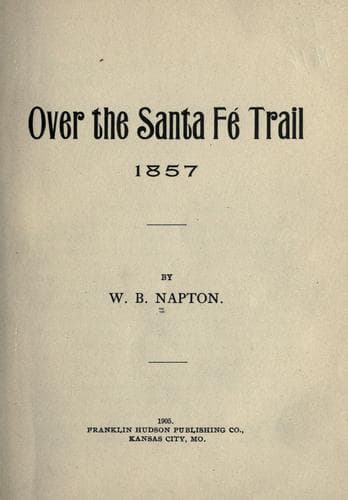
Over the Santa Fé Trail, 1857Napton, William Barclay
History
Over the Santa Fé Trail, 1857
Napton, William Barclay
Santa Fe National Historic Trail
A day or two after leaving Fort Pierre the boat was signalled by Big
Head and his band who came approaching the river from the northeast,
across a vast bottom prairie, and who were conspicuous on account
of their absence at the council at Fort Pierre, and this fact was
construed by the agent and others connected with the Indians as an
indication of his continued unfriendliness or possible open hostility.
The boat was steaming along against a strong current, but near the
shore, when this band was seen approaching, giving signals for the boat
to land, which the agent immediately ordered. While the landing was
being made, the band, several hundred in number, had approached within
two hundred yards of the river bank, when they formed an irregular
line and halting, fired towards us a number of guns, the bullets from
which went whistling through the air above us. For a while it was
thought they had attacked us, but in a few moments it was discovered
that this demonstration of fire arms was intended as a salute for
the agent. The boat having landed, Big Head and his sub-chiefs and
warriors came on board, assembled in the cabin, where a council was
duly organized. Big Head made a great speech, in which he gave some
excuse for not attending the general council at Fort Pierre, claiming
to be altogether peaceful and friendly, and anxious to accept the
annuities from the great father at Washington. Big Head was a heavy
built ugly Indian unlike most of his tribe, who were generally tall,
well proportioned, fine-looking fellows.
Singularly enough, no buffalo were seen by us while ascending the river
in 1858. Several years later, in 1865, going up the river to the mines
in Montana, we saw great herds of them along the river for more than
a thousand miles, and killed as many as were needful to supply the
boats with meat. They were frequently found crossing the river in such
numbers as to prevent navigation of the boat. Occasionally we would
approach them massed under a bluff-bank, after swimming the river, too
steep to allow exit from the water, and here they would stand or swim
around in the water (accumulated here from the opposite side of the
river) exhausted and apparently bewildered.
Under these circumstances, if we were in need of meat, the captain
would land the boat below them, the yawl-boat would be lowered, manned
with oarsmen, and a man provided with a rope and butcher-knife,
and rowed up to the heads of the animals as they swam around. The
rope would be tied around the horns, the buffalo killed with the
butcher-knife, the carcass floated down to the boat, when the hoisting
tackle would be attached to it and lifted aboard, where it was handily
skinned and quartered.
Public-domain text, read in full here on John Shaqi.
Reviews
Reviews
No reviews yet
Be the first to share your thoughts on this work.
Join the Discussion
Join the discussion
Sign in to leave a comment or review.
Sign InorCreate an account