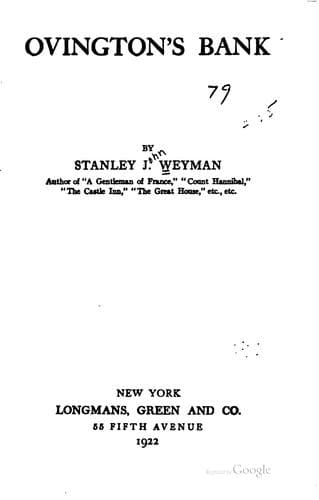
Banks and banking -- Fiction; England -- Social life and customs -- 19th century -- Fiction; Love stories
“I will bear it,” she answered. “And it will not last. And see, I am
not afraid now—or only a little! I shall think of you, and it will be
nothing.”
Oh, but the birds were singing now and the brook was sparkling as it
rippled over the shallows towards the deep pool.
Presently, “When will you tell him?” she asked; and she asked it, with
scarce a quaver in her voice.
“As soon as I can. The sooner the better. This is Saturday. I will see
him on Monday morning.”
“But isn’t that—market-day?” faintly. “Can you get away?”
“Does anything matter beside this?” he replied. “The sooner, dear, the
tooth is pulled, the better. There is only, one thing I fear.”
“I think you fear nothing,” she rejoined, gazing at him with admiring
eyes. “But what is it?”
“That someone should be before us. That someone should tell him before
I do. And he should think us what we are not, Jos—cowards.”
“I see,” she answered thoughtfully. “Yes,” with a sigh. “Then, on
Monday. I shall sleep the better when it is over, even if I sleep in
disgrace.”
“I know,” he said; and he saw with a pang that her color ebbed. But her
eyes still met his and were brave, and she smiled to reassure him.
“I will not mind what comes,” she whispered, “if only we are not
parted.”
“We shall not be parted for ever,” he assured her. “If we are true to
one another, not even your father can part us—in the end.”
CHAPTER XI
Josina had put a brave face on the matter, but when she came down to
breakfast on the Monday, the girl was almost sick with apprehension.
Her hands were cold, and as she sat at table she could not raise her
eyes from her plate. The habit of years is not to be overcome in an
hour, and that which the girl had to face was beyond doubt formidable.
She had passed out of childhood, but in that house she was still a
child. She was expected to be silent, to efface herself before her
elders, to have no views but their views, and no wishes that went
beyond theirs. Her daily life was laid out for her, and she must
conform or she would be called to heel. On love and marriage she must
have no mind of her own, but must think as her father permitted. If he
chose she would be her cousin’s wife, if he did not choose the two
would be parted. She could guess how he would treat her if she resisted
his will, or even his whim, in that matter.
And now she must resist his will in a far worse case. Arthur was her
cousin. But Clement? She was not supposed even to know him. Yet she
must own him, she must avow her love for him, she must confess to
secret meetings with him and stolen interviews. She must be prepared
for looks of horror, for uplifted hands and scandalized faces, and to
hear shameful things said of him; to hear him spoken of as an upstart,
belonging to a class beneath her, a person with whom she ought never to
have come in contact, one whom her father would not think of admitting
to his table!
Public-domain text, read in full here on John Shaqi.
Reviews
Reviews
No reviews yet
Be the first to share your thoughts on this work.
Elsewhere in the archive
Join the Discussion
Join the discussion
Sign in to leave a comment or review.
Sign InorCreate an account