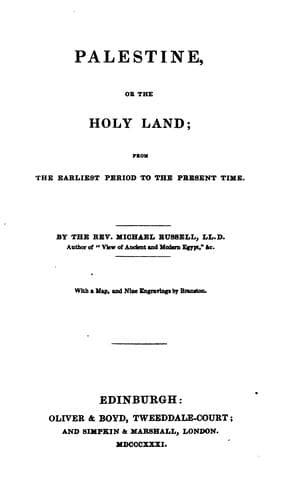
Palestine, or, the Holy Land: From the Earliest Period to the Present TimeRussell, Michael
History
Palestine, or, the Holy Land: From the Earliest Period to the Present Time
Russell, Michael
Palestine -- Description and travel; Palestine -- History
We have been the more careful to collect these fragments of personal
history, because it is chiefly from them that the few rays of light
are reflected which illustrate the state of society at the era of the
Hebrew commonwealth. That the times in which the judges ruled were
barbarous and unsettled is rendered manifest, not less by the general
tenor of events, than by the qualities which predominated in the public
mind during the long period that elapsed between the death of Joshua and
the reign of Solomon. These notices also convey to us some degree of
information, in regard to the political relations which subsisted among
the Syrian tribes prior to the commencement of the regal government at
Jerusalem. The wars which were carried on at that remote epoch seem not
to have been waged with any view to permanent conquest, or even to
territorial aggrandizement, but merely to revenge an insult, to exact a
ransom, or to abstract slaves and cattle. The history of the judges
supplies no facts which would lead us to infer that during any of tie
servitudes, which for their repeated transgressions were inflicted on
the Hebrews, their lands were taken from them, or their cities destroyed
by their conquerors. It was not till a later age that a more systematic
plan of conquest was formed by the powerful princes who governed beyond
the Euphrates and on the banks of the Nile, and who, not content with the
uncertain submission of tributaries, resolved to reduce the Israelites for
ever to the condition of subjects or of bondmen.
The account which has been given of the political constitution of the
ancient Jews would not be complete were we to omit all notice of the tribe
of Levi, the duties and revenues of which were fixed by peculiar laws. It
may, perhaps, be thought by some readers, that this institution rested on
a basis altogether spiritual; but, upon suitable inquiry, it will be found
that the Levitical offices comprehended a great variety of avocations,
much more closely connected with secular life than with the ministry of
the tabernacle, or with the services which were due to the priesthood.
This sacred tribe, indeed, supplied to the whole nation of the Israelites
their judges, lawyers, scribes, teachers, and physicians; for Moses, in
imitation of the Egyptians, in whose wisdom he was early and deeply
instructed, had thought proper to make the learned professions hereditary
in the several families of Levi's descendants.
Public-domain text, read in full here on John Shaqi.
Reviews
Reviews
No reviews yet
Be the first to share your thoughts on this work.
Join the Discussion
Join the discussion
Sign in to leave a comment or review.
Sign InorCreate an account